post - lab reflection: thinking about our planet\nanswer the questions below using what you observed in the…
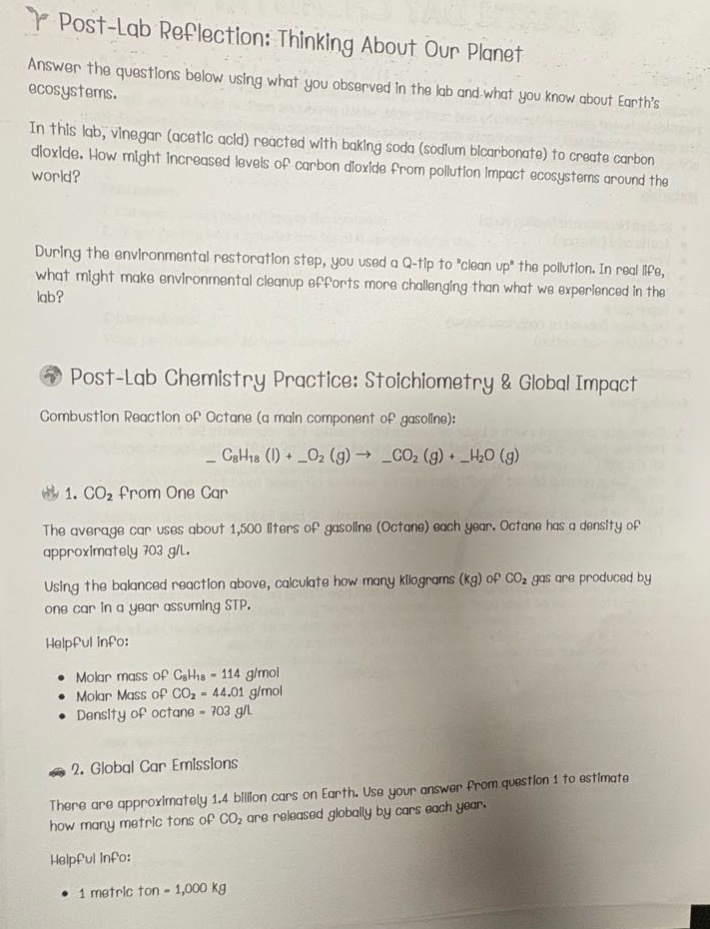
post - lab reflection: thinking about our planet\nanswer the questions below using what you observed in the lab and what you know about earths ecosystems.\nin this lab, vinegar (acetic acid) reacted with baking soda (sodium bicarbonate) to create carbon dioxide. how might increased levels of carbon dioxide from pollution impact ecosystems around the world?\nduring the environmental restoration step, you used a q - tip to \clean up\ the pollution. in real life, what might make environmental cleanup efforts more challenging than what we experienced in the lab?\npost - lab chemistry practice: stoichiometry & global impact\ncombustion reaction of octane (a main component of gasoline):\n_$c_{8}h_{18}(l)+o_{2}(g)\to_co_{2}(g)+h_{2}o(g)$\n1. $co_{2}$ from one car\nthe average car uses about 1,500 liters of gasoline (octane) each year. octane has a density of approximately 703 g/l.\nusing the balanced reaction above, calculate how many kilograms (kg) of $co_{2}$ gas are produced by one car in a year assuming stp.\nhelpful info:\n- molar mass of $c_{8}h_{18}=114$ g/mol\n- molar mass of $co_{2}=44.01$ g/mol\n- density of octane = 703 g/l\n2. global car emissions\nthere are approximately 1.4 billion cars on earth. use your answer from question 1 to estimate how many metric tons of $co_{2}$ are released globally by cars each year.\nhelpful info:\n- 1 metric ton = 1,000 kg
Answer
Explanation:
Step1: Balance the combustion reaction of octane
The balanced equation for the combustion of octane is $2C_8H_{18}(l)+25O_2(g)\rightarrow16CO_2(g) + 18H_2O(g)$
Step2: Calculate the mass of octane used by one car in a year
Given the volume of gasoline (octane) used per year $V = 1500L$ and density $\rho=703g/L$. Using the formula $m=\rho V$, we have $m = 703g/L\times1500L=1054500g = 1054.5kg$
Step3: Calculate the number of moles of octane
The molar mass of octane $C_8H_{18}$ is $M_{C_8H_{18}}=114g/mol$. Using the formula $n=\frac{m}{M}$, we get $n_{C_8H_{18}}=\frac{1054500g}{114g/mol}=9250mol$
Step4: Calculate the number of moles of $CO_2$ produced from one - car's octane consumption
From the balanced equation, the mole - ratio of $C_8H_{18}$ to $CO_2$ is $2:16$ or $1:8$. So, if $n_{C_8H_{18}} = 9250mol$, then $n_{CO_2}=8\times n_{C_8H_{18}}=8\times9250mol = 74000mol$
Step5: Calculate the mass of $CO_2$ produced by one car in a year
The molar mass of $CO_2$ is $M_{CO_2}=44.01g/mol$. Using the formula $m = n\times M$, we have $m_{CO_2}=74000mol\times44.01g/mol=3256740g=3256.74kg$
Step6: Calculate the global $CO_2$ emissions from cars
There are approximately $N = 1.4\times10^{9}$ cars. The total mass of $CO_2$ emissions $m_{total}=m_{CO_2}\times N$ $m_{total}=3256.74kg\times1.4\times 10^{9}=4.559436\times10^{12}kg$ Since $1$ metric ton $ = 1000kg$, $m_{total}=\frac{4.559436\times10^{12}kg}{1000}=4.559436\times10^{9}$ metric tons
Answer:
- $3256.74kg$
- $4.559436\times 10^{9}$ metric tons