practice\nfor each of the following, use an activity series to determine which single displacement reactions…
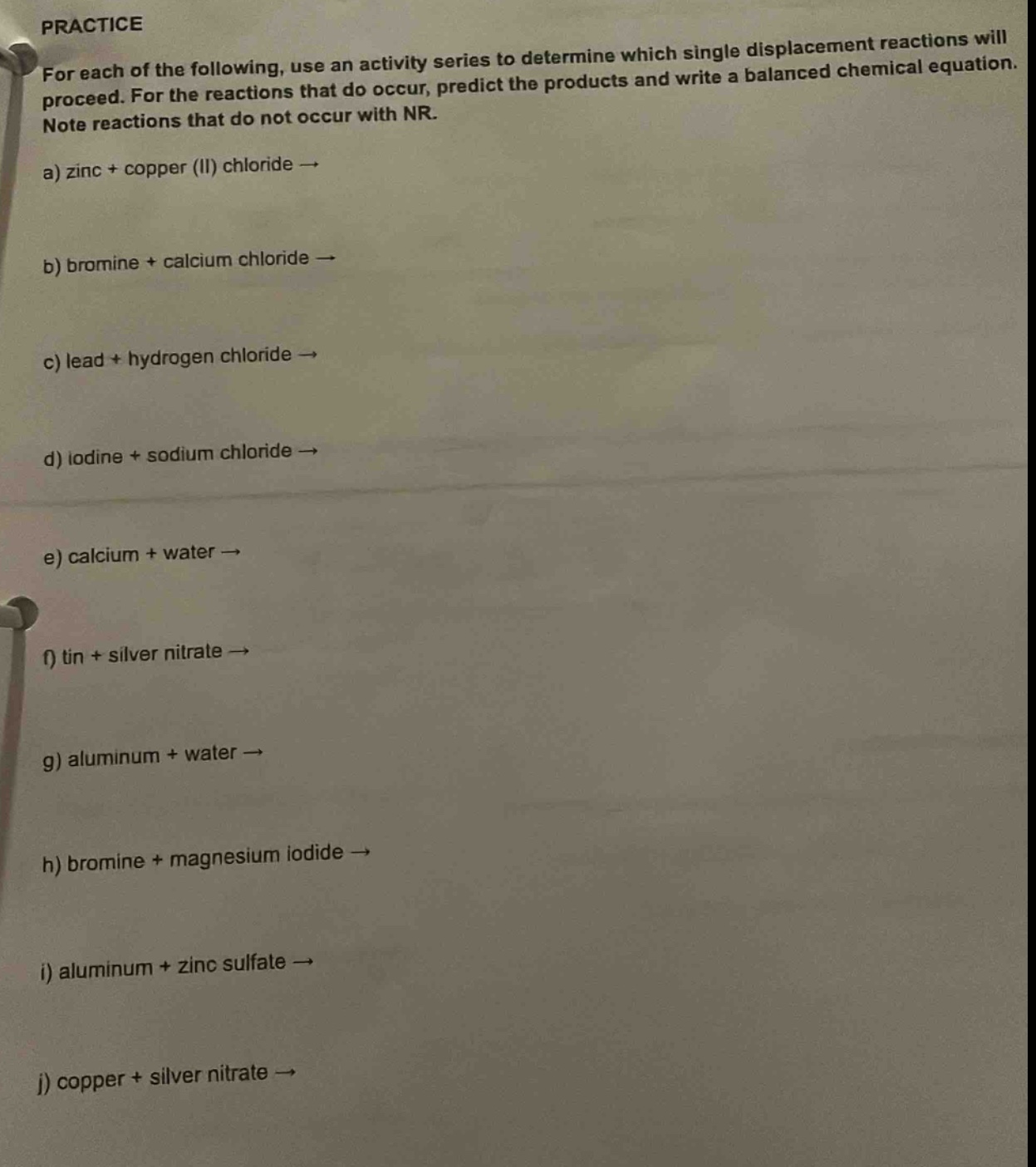
practice\nfor each of the following, use an activity series to determine which single displacement reactions will proceed. for the reactions that do occur, predict the products and write a balanced chemical equation. note reactions that do not occur with nr.\na) zinc + copper (ii) chloride →\nb) bromine + calcium chloride →\nc) lead + hydrogen chloride →\nd) iodine + sodium chloride →\ne) calcium + water →\nf) tin + silver nitrate →\ng) aluminum + water →\nh) bromine + magnesium iodide →\ni) aluminum + zinc sulfate →\nj) copper + silver nitrate →
Answer
Explanation:
Step1: Recall activity - series concept
The more reactive element can displace the less reactive element from its compound.
Step2: Analyze reaction a
Zinc is more reactive than copper. The reaction is $Zn + CuCl_{2}\rightarrow ZnCl_{2}+Cu$.
Step3: Analyze reaction b
Chlorine is more reactive than bromine. So, $Br_{2}+CaCl_{2}\rightarrow NR$.
Step4: Analyze reaction c
Lead is more reactive than hydrogen. The reaction is $Pb + 2HCl\rightarrow PbCl_{2}+H_{2}$.
Step5: Analyze reaction d
Chlorine is more reactive than iodine. So, $I_{2}+NaCl\rightarrow NR$.
Step6: Analyze reaction e
Calcium reacts with water. The reaction is $Ca + 2H_{2}O\rightarrow Ca(OH){2}+H{2}$.
Step7: Analyze reaction f
Tin is more reactive than silver. The reaction is $Sn + 2AgNO_{3}\rightarrow Sn(NO_{3})_{2}+2Ag$.
Step8: Analyze reaction g
Aluminum reacts with water. The reaction is $2Al + 6H_{2}O\rightarrow 2Al(OH){3}+3H{2}$.
Step9: Analyze reaction h
Bromine is more reactive than iodine. The reaction is $Br_{2}+MgI_{2}\rightarrow MgBr_{2}+I_{2}$.
Step10: Analyze reaction i
Aluminum is more reactive than zinc. The reaction is $2Al + 3ZnSO_{4}\rightarrow Al_{2}(SO_{4})_{3}+3Zn$.
Step11: Analyze reaction j
Copper is more reactive than silver. The reaction is $Cu + 2AgNO_{3}\rightarrow Cu(NO_{3})_{2}+2Ag$.
Answer:
a) $Zn + CuCl_{2}\rightarrow ZnCl_{2}+Cu$ b) $Br_{2}+CaCl_{2}\rightarrow NR$ c) $Pb + 2HCl\rightarrow PbCl_{2}+H_{2}$ d) $I_{2}+NaCl\rightarrow NR$ e) $Ca + 2H_{2}O\rightarrow Ca(OH){2}+H{2}$ f) $Sn + 2AgNO_{3}\rightarrow Sn(NO_{3}){2}+2Ag$ g) $2Al + 6H{2}O\rightarrow 2Al(OH){3}+3H{2}$ h) $Br_{2}+MgI_{2}\rightarrow MgBr_{2}+I_{2}$ i) $2Al + 3ZnSO_{4}\rightarrow Al_{2}(SO_{4}){3}+3Zn$ j) $Cu + 2AgNO{3}\rightarrow Cu(NO_{3})_{2}+2Ag$