practice problems\n11. write the chemical equation that relates to each of the following word equations…
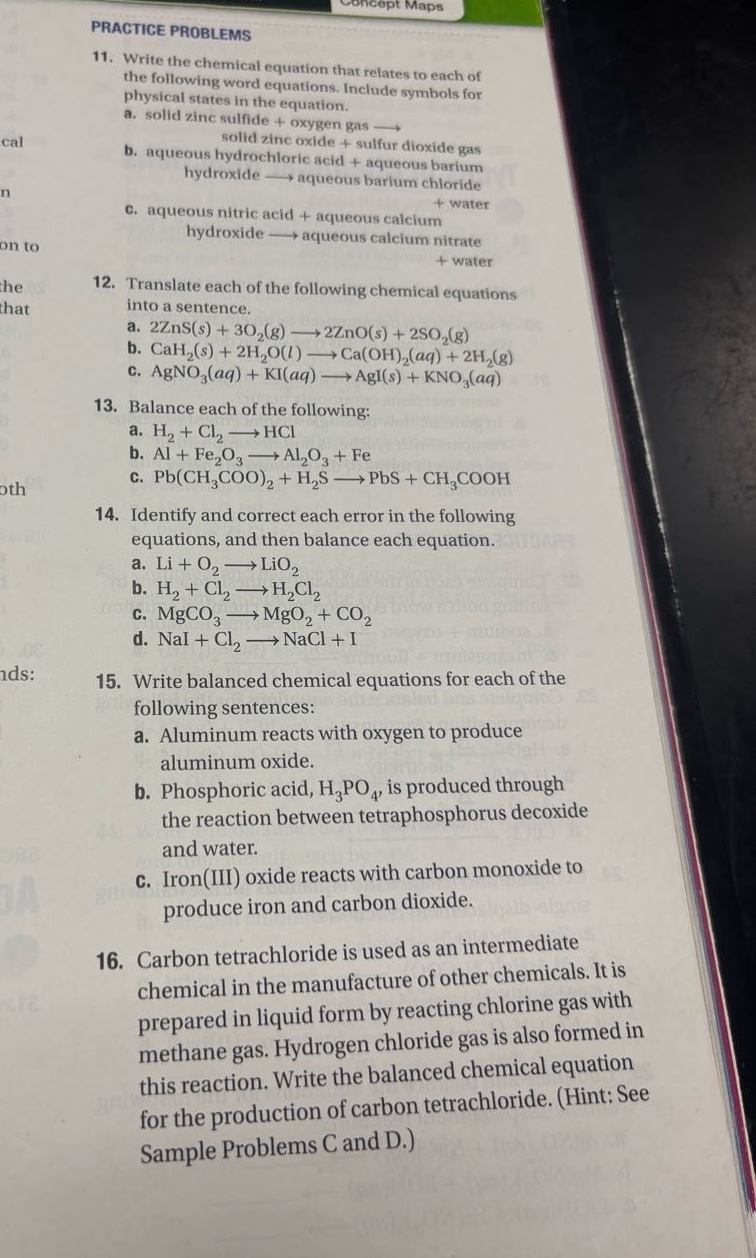
practice problems\n11. write the chemical equation that relates to each of the following word equations. include symbols for physical states in the equation.\n a. solid zinc sulfide + oxygen gas → solid zinc oxide + sulfur dioxide gas\n b. aqueous hydrochloric acid + aqueous barium hydroxide → aqueous barium chloride + water\n c. aqueous nitric acid + aqueous calcium hydroxide → aqueous calcium nitrate + water\n12. translate each of the following chemical equations into a sentence.\n a. 2zns(s) + 3o₂(g) → 2zno(s) + 2so₂(g)\n b. cah₂(s) + 2h₂o(l) → ca(oh)₂(aq) + 2h₂(g)\n c. agno₃(aq) + ki(aq) → agi(s) + kno₃(aq)\n13. balance each of the following:\n a. h₂ + cl₂ → hcl\n b. al + fe₂o₃ → al₂o₃ + fe\n c. pb(ch₃coo)₂ + h₂s → pbs + ch₃cooh\n14. identify and correct each error in the following equations, and then balance each equation.\n a. li + o₂ → lio₂\n b. h₂ + cl₂ → h₂cl₂\n c. mgco₃ → mgo₂ + co₂\n d. nai + cl₂ → nacl + i\n15. write balanced chemical equations for each of the following sentences:\n a. aluminum reacts with oxygen to produce aluminum oxide.\n b. phosphoric acid, h₃po₄, is produced through the reaction between tetraphosphorus decoxide and water.\n c. iron(iii) oxide reacts with carbon monoxide to produce iron and carbon dioxide.\n16. carbon tetrachloride is used as an intermediate chemical in the manufacture of other chemicals. it is prepared in liquid form by reacting chlorine gas with methane gas. hydrogen chloride gas is also formed in this reaction. write the balanced chemical equation for the production of carbon tetrachloride. (hint: see sample problems c and d.)
Answer
11.
a.
Explanation:
Step1: Write reactants
The reactants are solid zinc sulfide ($\text{ZnS}(s)$) and oxygen gas ($\text{O}_2(g)$). $\text{ZnS}(s)+\text{O}_2(g)$
Step2: Write products
The products are solid zinc oxide ($\text{ZnO}(s)$) and sulfur - dioxide gas ($\text{SO}_2(g)$). $\text{ZnS}(s)+\text{O}_2(g)\rightarrow\text{ZnO}(s)+\text{SO}_2(g)$
Step3: Balance the equation
$2\text{ZnS}(s) + 3\text{O}_2(g)\rightarrow2\text{ZnO}(s)+2\text{SO}_2(g)$
b.
Explanation:
Step1: Write reactants
The reactants are aqueous hydrochloric acid ($\text{HCl}(aq)$) and aqueous barium hydroxide ($\text{Ba(OH)}_2(aq)$). $\text{HCl}(aq)+\text{Ba(OH)}_2(aq)$
Step2: Write products
The products are aqueous barium chloride ($\text{BaCl}_2(aq)$) and water ($\text{H}_2\text{O}(l)$). $\text{HCl}(aq)+\text{Ba(OH)}_2(aq)\rightarrow\text{BaCl}_2(aq)+\text{H}_2\text{O}(l)$
Step3: Balance the equation
$2\text{HCl}(aq)+\text{Ba(OH)}_2(aq)\rightarrow\text{BaCl}_2(aq)+2\text{H}_2\text{O}(l)$
c.
Explanation:
Step1: Write reactants
The reactants are aqueous nitric acid ($\text{HNO}_3(aq)$) and aqueous calcium hydroxide ($\text{Ca(OH)}_2(aq)$). $\text{HNO}_3(aq)+\text{Ca(OH)}_2(aq)$
Step2: Write products
The products are aqueous calcium nitrate ($\text{Ca(NO}_3)_2(aq)$) and water ($\text{H}_2\text{O}(l)$). $\text{HNO}_3(aq)+\text{Ca(OH)}_2(aq)\rightarrow\text{Ca(NO}_3)_2(aq)+\text{H}_2\text{O}(l)$
Step3: Balance the equation
$2\text{HNO}_3(aq)+\text{Ca(OH)}_2(aq)\rightarrow\text{Ca(NO}_3)_2(aq)+2\text{H}_2\text{O}(l)$
12.
a.
Brief Explanations:
Two moles of solid zinc sulfide react with three moles of oxygen gas to produce two moles of solid zinc oxide and two moles of sulfur - dioxide gas.
Answer:
Two moles of solid zinc sulfide react with three moles of oxygen gas to produce two moles of solid zinc oxide and two moles of sulfur - dioxide gas.
b.
Brief Explanations:
One mole of solid calcium hydride reacts with two moles of liquid water to produce one mole of aqueous calcium hydroxide and two moles of hydrogen gas.
Answer:
One mole of solid calcium hydride reacts with two moles of liquid water to produce one mole of aqueous calcium hydroxide and two moles of hydrogen gas.
c.
Brief Explanations:
One mole of aqueous silver nitrate reacts with one mole of aqueous potassium iodide to produce one mole of solid silver iodide and one mole of aqueous potassium nitrate.
Answer:
One mole of aqueous silver nitrate reacts with one mole of aqueous potassium iodide to produce one mole of solid silver iodide and one mole of aqueous potassium nitrate.
13.
a.
Explanation:
Step1: Initial equation
$\text{H}_2+\text{Cl}_2\rightarrow\text{HCl}$
Step2: Balance hydrogen and chlorine
$\text{H}_2+\text{Cl}_2\rightarrow2\text{HCl}$
b.
Explanation:
Step1: Initial equation
$\text{Al}+\text{Fe}_2\text{O}_3\rightarrow\text{Al}_2\text{O}_3+\text{Fe}$
Step2: Balance aluminum
$2\text{Al}+\text{Fe}_2\text{O}_3\rightarrow\text{Al}_2\text{O}_3+\text{Fe}$
Step3: Balance iron
$2\text{Al}+\text{Fe}_2\text{O}_3\rightarrow\text{Al}_2\text{O}_3 + 2\text{Fe}$
c.
Explanation:
Step1: Initial equation
$\text{Pb(CH}_3\text{COO})_2+\text{H}_2\text{S}\rightarrow\text{PbS}+\text{CH}_3\text{COOH}$
Step2: Balance acetate groups
$\text{Pb(CH}_3\text{COO})_2+\text{H}_2\text{S}\rightarrow\text{PbS}+2\text{CH}_3\text{COOH}$
14.
a.
Explanation:
Step1: Identify error
The correct product of lithium reacting with oxygen is lithium oxide $\text{Li}_2\text{O}$, not $\text{LiO}_2$.
Step2: Correct equation
$\text{Li}+\text{O}_2\rightarrow\text{Li}_2\text{O}$
Step3: Balance the equation
$4\text{Li}+\text{O}_2\rightarrow2\text{Li}_2\text{O}$
b.
Explanation:
Step1: Identify error
The product of hydrogen and chlorine reaction is $\text{HCl}$, not $\text{H}_2\text{Cl}_2$.
Step2: Correct equation
$\text{H}_2+\text{Cl}_2\rightarrow\text{HCl}$
Step3: Balance the equation
$\text{H}_2+\text{Cl}_2\rightarrow2\text{HCl}$
c.
Explanation:
Step1: Identify error
The decomposition of magnesium carbonate gives magnesium oxide $\text{MgO}$, not $\text{MgO}_2$.
Step2: Correct equation
$\text{MgCO}_3\rightarrow\text{MgO}+\text{CO}_2$
Step3: Balance the equation
The equation is already balanced: $\text{MgCO}_3\rightarrow\text{MgO}+\text{CO}_2$
d.
Explanation:
Step1: Identify error
The product of sodium iodide and chlorine reaction should be $\text{NaCl}$ and $\text{I}_2$, not $\text{NaCl}$ and $\text{I}$.
Step2: Correct equation
$\text{NaI}+\text{Cl}_2\rightarrow\text{NaCl}+\text{I}_2$
Step3: Balance the equation
$2\text{NaI}+\text{Cl}_2\rightarrow2\text{NaCl}+\text{I}_2$
15.
a.
Explanation:
Step1: Write reactants
Aluminum ($\text{Al}$) and oxygen ($\text{O}_2$). $\text{Al}+\text{O}_2$
Step2: Write products
Aluminum oxide ($\text{Al}_2\text{O}_3$). $\text{Al}+\text{O}_2\rightarrow\text{Al}_2\text{O}_3$
Step3: Balance the equation
$4\text{Al}+3\text{O}_2\rightarrow2\text{Al}_2\text{O}_3$
b.
Explanation:
Step1: Write reactants
Tetraphosphorus decoxide ($\text{P}4\text{O}{10}$) and water ($\text{H}_2\text{O}$). $\text{P}4\text{O}{10}+\text{H}_2\text{O}$
Step2: Write products
Phosphoric acid ($\text{H}_3\text{PO}_4$). $\text{P}4\text{O}{10}+\text{H}_2\text{O}\rightarrow\text{H}_3\text{PO}_4$
Step3: Balance the equation
$\text{P}4\text{O}{10}+6\text{H}_2\text{O}\rightarrow4\text{H}_3\text{PO}_4$
c.
Explanation:
Step1: Write reactants
Iron(III) oxide ($\text{Fe}_2\text{O}_3$) and carbon monoxide ($\text{CO}$). $\text{Fe}_2\text{O}_3+\text{CO}$
Step2: Write products
Iron ($\text{Fe}$) and carbon dioxide ($\text{CO}_2$). $\text{Fe}_2\text{O}_3+\text{CO}\rightarrow\text{Fe}+\text{CO}_2$
Step3: Balance the equation
$\text{Fe}_2\text{O}_3 + 3\text{CO}\rightarrow2\text{Fe}+3\text{CO}_2$
16.
Explanation:
Step1: Write reactants
Chlorine gas ($\text{Cl}_2$) and methane gas ($\text{CH}_4$). $\text{Cl}_2+\text{CH}_4$
Step2: Write products
Carbon tetrachloride ($\text{CCl}_4$) and hydrogen chloride gas ($\text{HCl}$). $\text{Cl}_2+\text{CH}_4\rightarrow\text{CCl}_4+\text{HCl}$
Step3: Balance the equation
$4\text{Cl}_2+\text{CH}_4\rightarrow\text{CCl}_4 + 4\text{HCl}$