practice problems: a. calculate the molality, freezing point, and boiling point for each of the following…
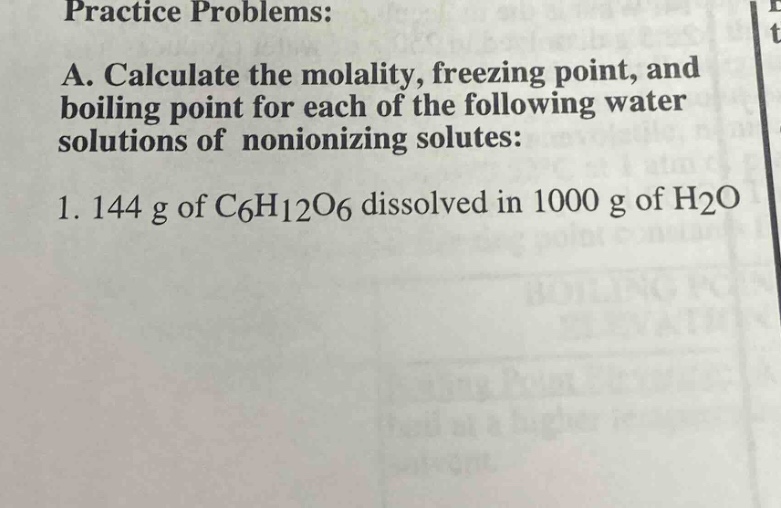
practice problems: a. calculate the molality, freezing point, and boiling point for each of the following water solutions of nonionizing solutes: 1. 144 g of c6h12o6 dissolved in 1000 g of h2o
Answer
Explanation:
Step1: Calculate molar mass of $C_6H_{12}O_6$
The molar mass of $C_6H_{12}O_6$ ($M$) is calculated as follows: $M=(6\times12.01 + 12\times1.01+6\times16.00)\text{ g/mol}=180.18\text{ g/mol}$
Step2: Calculate number of moles of $C_6H_{12}O_6$
The number of moles ($n$) of $C_6H_{12}O_6$ is given by $n=\frac{m}{M}$, where $m = 144\text{ g}$. $n=\frac{144\text{ g}}{180.18\text{ g/mol}}\approx0.8\text{ mol}$
Step3: Calculate molality ($m$)
Molality is defined as the number of moles of solute per kilogram of solvent. The mass of solvent ($H_2O$) is $1000\text{ g}=1\text{ kg}$. $m=\frac{n}{m_{solvent}(kg)}=\frac{0.8\text{ mol}}{1\text{ kg}} = 0.8\text{ m}$
Step4: Calculate freezing - point depression ($\Delta T_f$)
For water, the cryoscopic constant $K_f = 1.86^{\circ}C/m$. Since the solute is non - ionizing, the van't Hoff factor $i = 1$. $\Delta T_f=iK_fm=(1)\times(1.86^{\circ}C/m)\times0.8\text{ m}=1.488^{\circ}C$ The freezing point of pure water is $T_{f}^0 = 0^{\circ}C$. So the freezing point of the solution $T_f=T_{f}^0-\Delta T_f=0 - 1.488^{\circ}C=- 1.488^{\circ}C$
Step5: Calculate boiling - point elevation ($\Delta T_b$)
For water, the ebullioscopic constant $K_b=0.512^{\circ}C/m$. Since $i = 1$ for non - ionizing solute. $\Delta T_b=iK_bm=(1)\times(0.512^{\circ}C/m)\times0.8\text{ m}=0.4096^{\circ}C$ The boiling point of pure water is $T_{b}^0 = 100^{\circ}C$. So the boiling point of the solution $T_b=T_{b}^0+\Delta T_b=100 + 0.4096^{\circ}C=100.4096^{\circ}C$
Answer:
Molality: $0.8\text{ m}$ Freezing point: $-1.488^{\circ}C$ Boiling point: $100.4096^{\circ}C$