5. predict the effect of decreasing the container volume for each equilibrium\n(a) 2 h₂o (g) + n₂ (g) ⇌ 2 h₂…
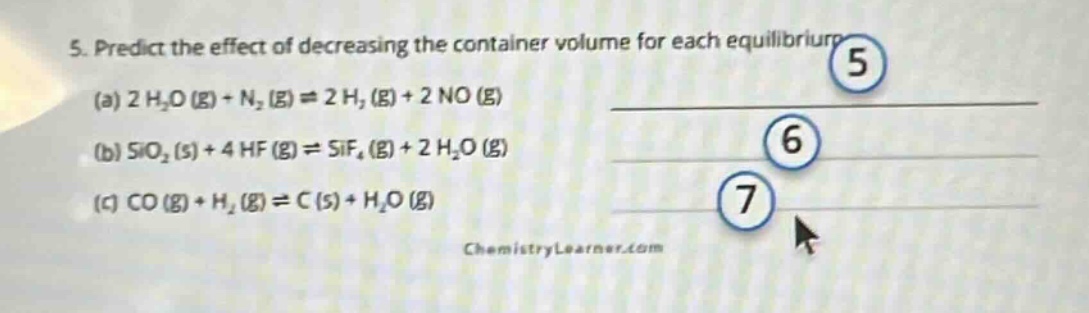
5. predict the effect of decreasing the container volume for each equilibrium\n(a) 2 h₂o (g) + n₂ (g) ⇌ 2 h₂ (g) + 2 no (g)\n(b) sio₂ (s) + 4 hf (g) ⇌ sif₄ (g) + 2 h₂o (g)\n(c) co (g) + h₂ (g) ⇌ c (s) + h₂o (g)
Answer
Explanation:
Step1: Recall Le - Chatelier's principle
When volume decreases, pressure increases and the equilibrium shifts to the side with fewer moles of gas.
Step2: Analyze reaction (a)
On the left - hand side, the number of moles of gas $n_{L}=2 + 1=3$. On the right - hand side, $n_{R}=2 + 2 = 4$. Decreasing volume (increasing pressure) will shift the equilibrium to the left.
Step3: Analyze reaction (b)
On the left - hand side, the number of moles of gas $n_{L}=4$. On the right - hand side, $n_{R}=1+2 = 3$. Decreasing volume (increasing pressure) will shift the equilibrium to the right.
Step4: Analyze reaction (c)
On the left - hand side, the number of moles of gas $n_{L}=1 + 1=2$. On the right - hand side, the number of moles of gas $n_{R}=1$ (since C is a solid and not counted in gas - phase mole calculations). Decreasing volume (increasing pressure) will shift the equilibrium to the right.
Answer:
(a) Shift to the left. (b) Shift to the right. (c) Shift to the right.