the production of water proceeds according to the following equation.\n2h₂(g) + o₂(g) → 2h₂o(g)\nwhich…
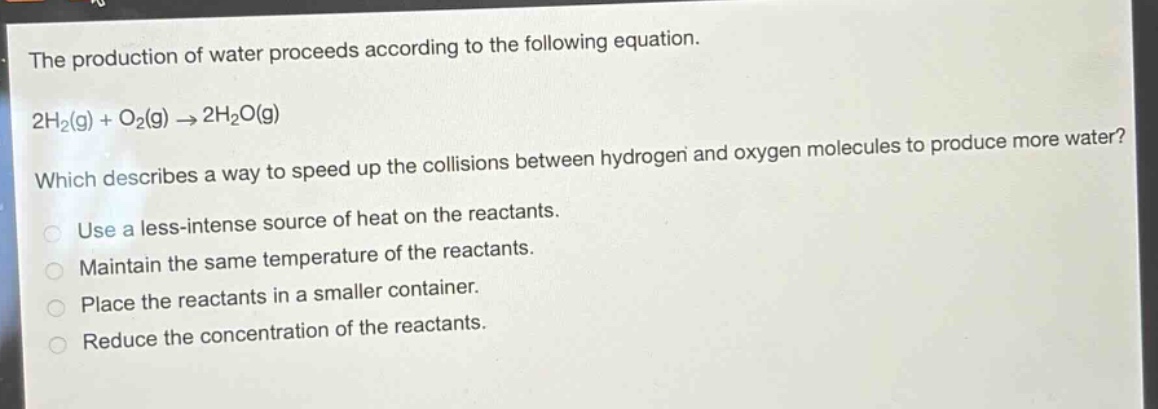
the production of water proceeds according to the following equation.\n2h₂(g) + o₂(g) → 2h₂o(g)\nwhich describes a way to speed up the collisions between hydrogen and oxygen molecules to produce more water?\nuse a less - intense source of heat on the reactants.\nmaintain the same temperature of the reactants.\nplace the reactants in a smaller container.\nreduce the concentration of the reactants.
Answer
Explanation:
Step1: Recall reaction - rate factors
Increasing temperature, concentration, or pressure (by reducing volume) speeds up reaction rates by increasing molecular collisions.
Step2: Analyze each option
- Using a less - intense heat source (lower temperature) slows down reactions, so it's wrong.
- Maintaining the same temperature doesn't increase the rate of collisions, so it's wrong.
- Placing reactants in a smaller container increases pressure. Higher pressure means more frequent collisions between hydrogen and oxygen molecules, speeding up the reaction. This is correct.
- Reducing the concentration of reactants decreases the number of molecules available for collision, slowing down the reaction, so it's wrong.
Answer:
Place the reactants in a smaller container.