the properties of two elements are listed below.\nwhich prediction is supported by the information in the…
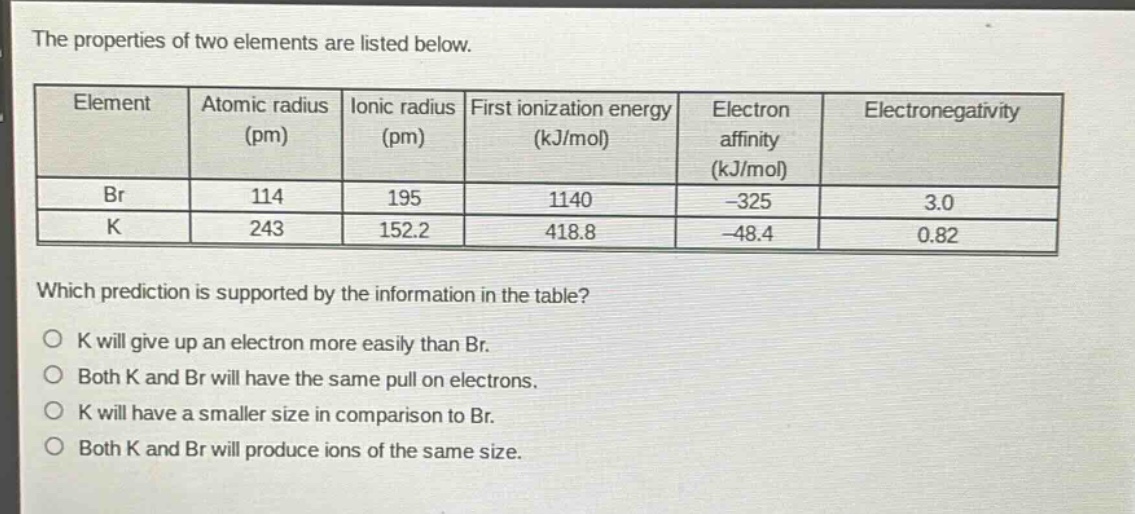
the properties of two elements are listed below.\nwhich prediction is supported by the information in the table?\nk will give up an electron more easily than br.\nboth k and br will have the same pull on electrons.\nk will have a smaller size in comparison to br.\nboth k and br will produce ions of the same size.
Answer
Explanation:
Step1: Analyze ionization energy
Ionization energy is the energy required to remove an electron from an atom. A lower first - ionization energy means it is easier for an atom to give up an electron. For (K), the first ionization energy is (418.8\ kJ/mol), and for (Br) it is (1140\ kJ/mol). Since (418.8<1140), (K) has a lower first ionization energy.
Step2: Analyze electronegativity
Electronegativity measures the pull of an atom on electrons in a chemical bond. (Br) has an electronegativity of (3.0) and (K) has an electronegativity of (0.82). So they do not have the same pull on electrons.
Step3: Analyze atomic radius
The atomic radius of (K) is (243\ pm) and that of (Br) is (114\ pm). So (K) has a larger atomic radius than (Br).
Step4: Analyze ionic radius
The ionic radius of (K) is (152.2\ pm) and that of (Br) is (195\ pm). So their ions are not of the same size.
Answer:
(K) will give up an electron more easily than (Br).