which property of liquids creates a meniscus in glass tubes as seen in the picture?\nadhesion\ncohesion\nmelt…
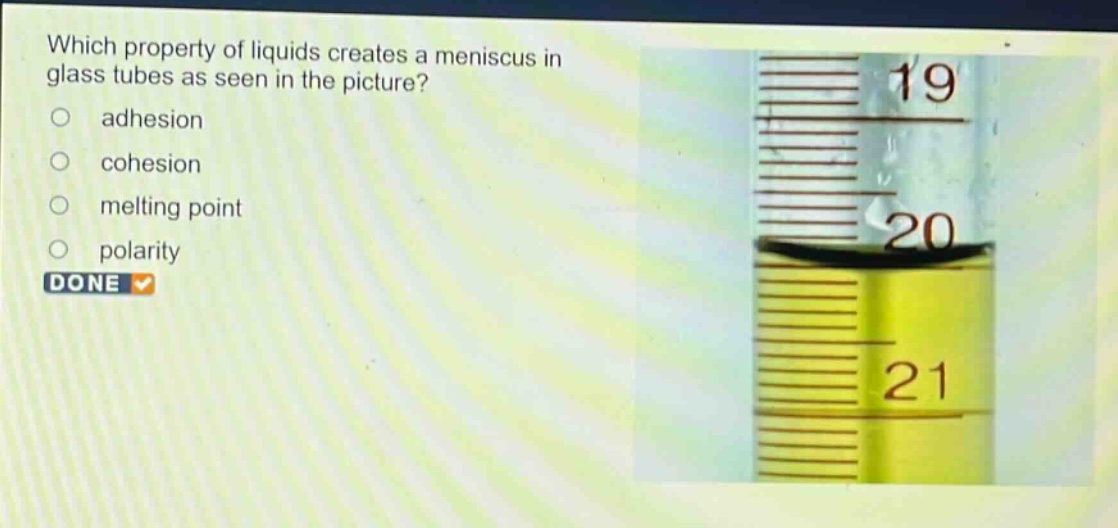
which property of liquids creates a meniscus in glass tubes as seen in the picture?\nadhesion\ncohesion\nmelting point\npolarity\ndone
Answer
Brief Explanations:
A meniscus is the curve seen at the top of a liquid in response to its container. This phenomenon occurs due to the interplay between two types of molecular forces: cohesion and adhesion. Cohesion refers to the intermolecular attraction between like molecules (e.g., water molecules attracting each other). Adhesion refers to the intermolecular attraction between unlike molecules (e.g., water molecules attracting the molecules of the glass container). When the adhesive forces between the liquid and the container walls are stronger than the cohesive forces within the liquid, the liquid tends to "climb" the walls, resulting in a concave meniscus, as seen with water in a glass tube. Conversely, if cohesive forces are stronger, a convex meniscus forms (e.g., mercury in glass). The image shows a concave meniscus, indicating that the attraction between the liquid and the glass (adhesion) is significant in its formation.
Answer:
adhesion