1 provide the identity of compound a (1 mark) and propose a mechanism for its conversion to compound b (6…
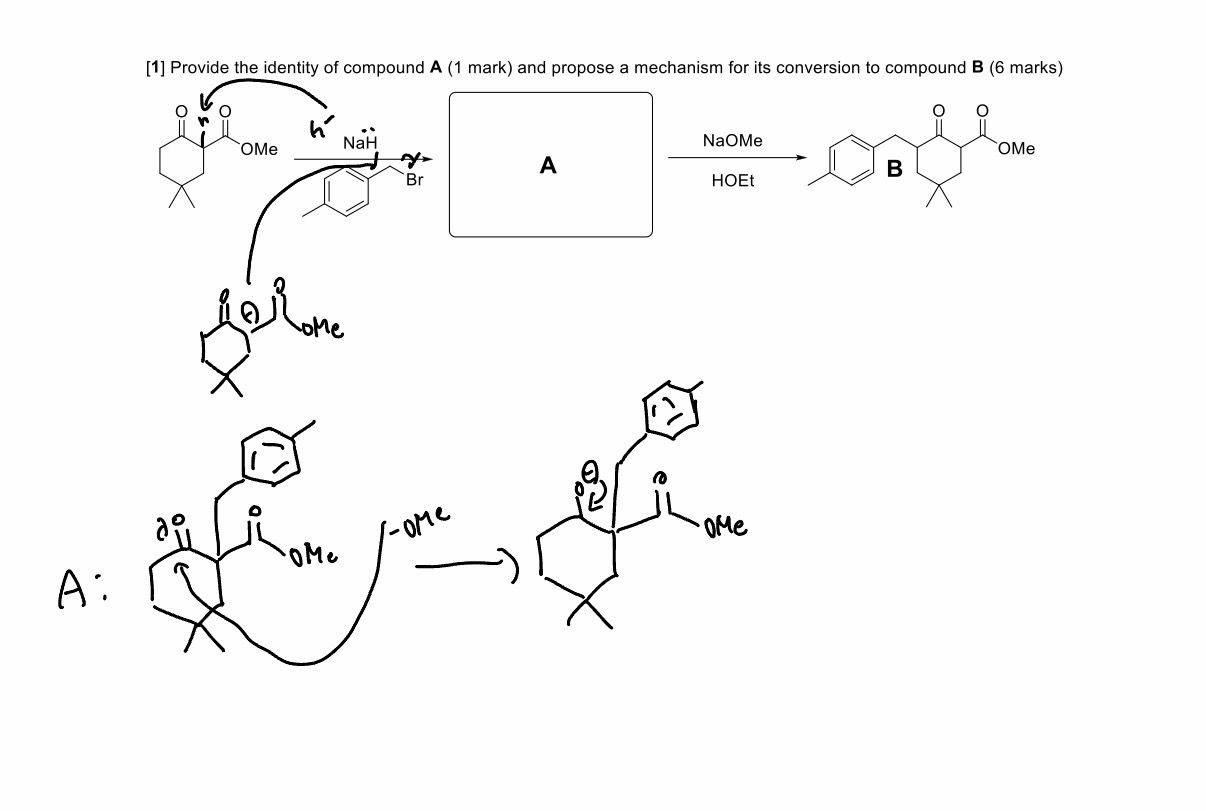
1 provide the identity of compound a (1 mark) and propose a mechanism for its conversion to compound b (6 marks)
Answer
Explanation:
Step1: Identify compound A
$\text{NaH}$ deprotonates the $\alpha$-carbon of the $\beta$-ketoester, followed by alkylation with 4-methylbenzyl bromide.
Step2: Deprotonation by methoxide
$\text{MeO}^-$ deprotonates the $\alpha$-carbon of the ester group in compound A.
Step3: Intramolecular nucleophilic attack
The resulting enolate attacks the ketone carbonyl carbon, forming a bicyclic alkoxide intermediate.
Step4: Retro-Dieckmann cleavage
The alkoxide reforms a carbonyl, breaking the bond between the original $\alpha$-carbon and the ketone carbon.
Step5: Proton transfer
The resulting enolate or carbanion is protonated by the solvent ($\text{HOEt}$ or $\text{MeOH}$) to yield the rearranged product.
Step6: Final product formation
The rearrangement results in the expansion/contraction of the ring system to form compound B.
Answer:
Compound A is methyl 1-(4-methylbenzyl)-4,4-dimethyl-2-oxocyclohexane-1-carboxylate. The mechanism for conversion to B involves: 1. Base-mediated deprotonation of the $\alpha$-position; 2. Intramolecular nucleophilic attack on the ketone carbonyl; 3. Retro-Claisen (or retro-Dieckmann) ring opening/rearrangement; 4. Protonation to yield the final $\beta$-ketoester B.