6. a quantity of oxygen occupies a volume of 19.2 l at stp. how many moles of oxygen are present? t = 273 k…
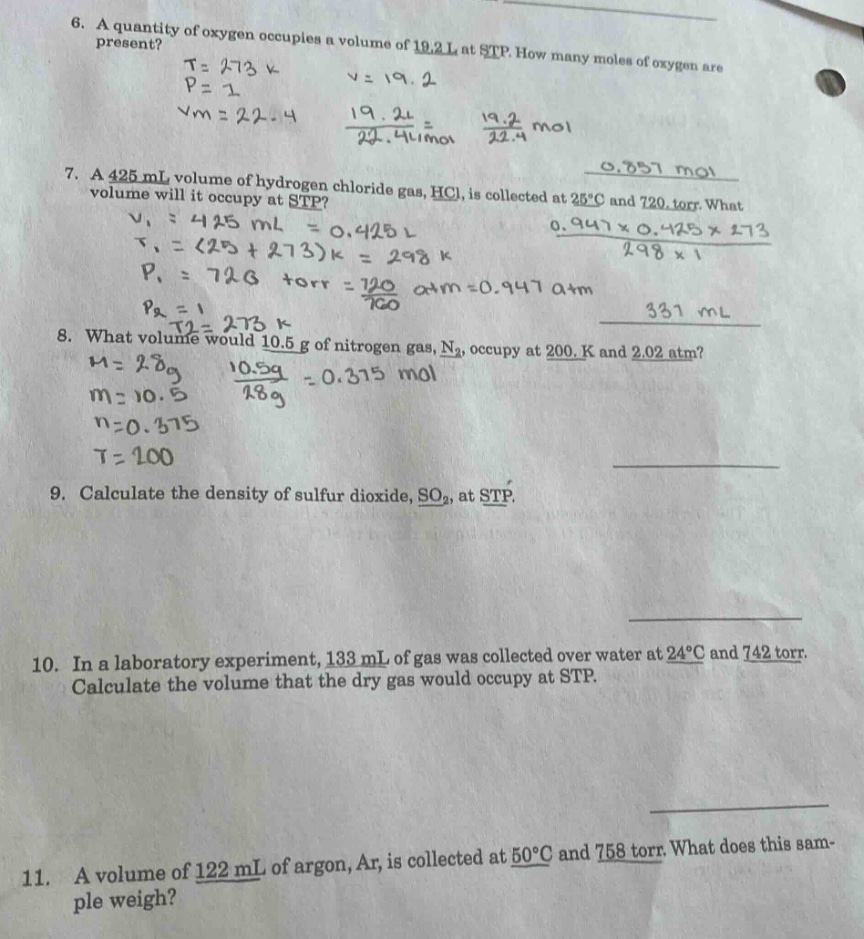
6. a quantity of oxygen occupies a volume of 19.2 l at stp. how many moles of oxygen are present? t = 273 k p = 1 v = 19.2 vm = 22.4 19.2l/22.4l/mol = 19.2/22.4 mol 7. a 425 ml volume of hydrogen chloride gas, hcl, is collected at 25°c and 720 torr. what volume will it occupy at stp? v1 = 425 ml = 0.425 l t1 = (25 + 273)k = 298 k p1 = 720 torr = 720/760 atm = 0.947 atm p2 = 1 t2 = 273 k 8. what volume would 10.5 g of nitrogen gas, n2, occupy at 200. k and 2.02 atm? m = 28g m = 10.5 10.5g/28g = 0.375 mol n = 0.375 t = 200 9. calculate the density of sulfur dioxide, so2, at stp. 10. in a laboratory experiment, 133 ml of gas was collected over water at 24°c and 742 torr. calculate the volume that the dry gas would occupy at stp. 11. a volume of 122 ml of argon, ar, is collected at 50°c and 758 torr. what does this sample weigh?
Answer
Explanation:
Step1: Recall molar - volume at STP
At STP (Standard Temperature and Pressure, $T = 273\ K$, $P=1\ atm$), the molar volume of any ideal gas, $V_m=22.4\ L/mol$.
Step2: Calculate moles of oxygen
We use the formula $n=\frac{V}{V_m}$, where $V$ is the volume of the gas and $V_m$ is the molar - volume. Given $V = 19.2\ L$ and $V_m = 22.4\ L/mol$. So $n=\frac{19.2\ L}{22.4\ L/mol}=0.857\ mol$.
Answer:
$0.857\ mol$
Explanation:
Step1: Convert initial conditions to SI units and use the combined gas law
The combined gas law is $\frac{P_1V_1}{T_1}=\frac{P_2V_2}{T_2}$. Given $V_1 = 425\ mL=0.425\ L$, $T_1=(25 + 273)K=298\ K$, $P_1 = 720\ torr=\frac{720}{760}\ atm\approx0.947\ atm$, $P_2 = 1\ atm$, $T_2 = 273\ K$.
Step2: Solve for $V_2$
$V_2=\frac{P_1V_1T_2}{T_1P_2}=\frac{0.947\ atm\times0.425\ L\times273\ K}{298\ K\times1\ atm}\approx0.337\ L = 337\ mL$
Answer:
$337\ mL$
Explanation:
Step1: Calculate moles of nitrogen gas
The molar mass of $N_2$ is $M = 28\ g/mol$. Given $m = 10.5\ g$, we use the formula $n=\frac{m}{M}$. So $n=\frac{10.5\ g}{28\ g/mol}=0.375\ mol$.
Step2: Use the ideal gas law $PV = nRT$ to find volume
The ideal gas law is $PV=nRT$, where $R = 0.0821\ L\cdot atm/(mol\cdot K)$, $T = 200\ K$, $P = 2.02\ atm$, $n = 0.375\ mol$. Rearranging for $V$, we get $V=\frac{nRT}{P}=\frac{0.375\ mol\times0.0821\ L\cdot atm/(mol\cdot K)\times200\ K}{2.02\ atm}\approx3.06\ L$
Answer:
$3.06\ L$
Explanation:
Step1: Recall molar - volume at STP and molar mass of $SO_2$
The molar mass of $SO_2$ is $M=(32 + 2\times16)\ g/mol=64\ g/mol$. At STP, $V_m = 22.4\ L/mol$.
Step2: Calculate density
Density $\rho=\frac{m}{V}$. For 1 mole of gas at STP, $m = M$ and $V = V_m$. So $\rho=\frac{M}{V_m}=\frac{64\ g/mol}{22.4\ L/mol}\approx2.86\ g/L$
Answer:
$2.86\ g/L$
Explanation:
Step1: Correct for water - vapor pressure
At $24^{\circ}C$, the vapor pressure of water, $P_{H_2O}=22.4\ torr$. So the pressure of the dry gas, $P_1=742 - 22.4=719.6\ torr=\frac{719.6}{760}\ atm\approx0.947\ atm$, $V_1 = 133\ mL = 0.133\ L$, $T_1=(24 + 273)K=297\ K$, $P_2 = 1\ atm$, $T_2 = 273\ K$.
Step2: Use the combined gas law
Using $\frac{P_1V_1}{T_1}=\frac{P_2V_2}{T_2}$, we get $V_2=\frac{P_1V_1T_2}{T_1P_2}=\frac{0.947\ atm\times0.133\ L\times273\ K}{297\ K\times1\ atm}\approx0.115\ L = 115\ mL$
Answer:
$115\ mL$
Explanation:
Step1: Convert conditions to SI units
$V = 122\ mL=0.122\ L$, $T=(50 + 273)K = 323\ K$, $P = 758\ torr=\frac{758}{760}\ atm\approx0.997\ atm$. The molar mass of $Ar$ is $M = 40\ g/mol$.
Step2: Use the ideal gas law to find moles
From $PV=nRT$, $n=\frac{PV}{RT}$, where $R = 0.0821\ L\cdot atm/(mol\cdot K)$. So $n=\frac{0.997\ atm\times0.122\ L}{0.0821\ L\cdot atm/(mol\cdot K)\times323\ K}\approx0.0045\ mol$.
Step3: Calculate mass
$m=nM$, so $m = 0.0045\ mol\times40\ g/mol=0.18\ g$
Answer:
$0.18\ g$