question 17 (1 point)\nat the end of a titration (equivalence point) involving hcl and naoh, which of the…
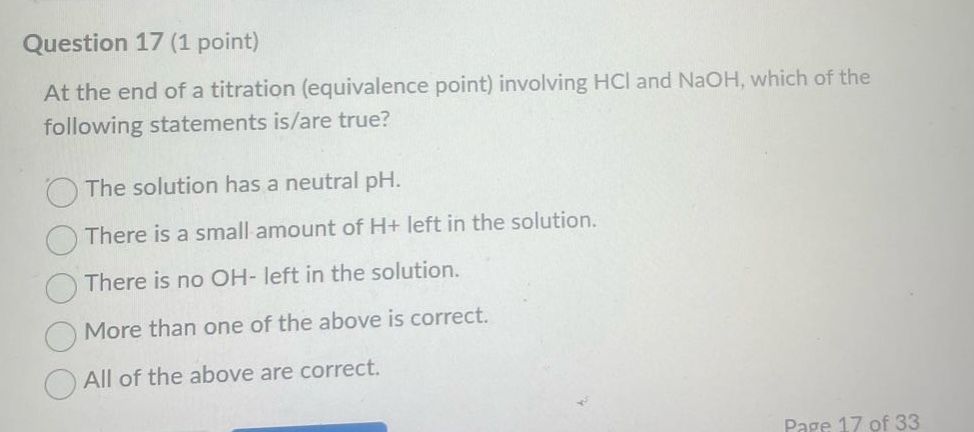
question 17 (1 point)\nat the end of a titration (equivalence point) involving hcl and naoh, which of the following statements is/are true?\nthe solution has a neutral ph.\nthere is a small amount of h+ left in the solution.\nthere is no oh- left in the solution.\nmore than one of the above is correct.\nall of the above are correct.
Answer
Answer:
The solution has a neutral pH.
Explanation:
Step1: Understand the reaction
HCl is a strong acid and NaOH is a strong base. They react as follows: $HCl + NaOH=NaCl + H_2O$.
Step2: Analyze the equivalence - point
At the equivalence - point of the titration of a strong acid and a strong base, the moles of $H^+$ from the acid are equal to the moles of $OH^-$ from the base. They completely neutralize each other.
Step3: Determine the pH
Since they completely neutralize each other, the resulting solution contains only the salt (NaCl) and water. The solution has a neutral pH of 7. There is no excess $H^+$ or $OH^-$ left in the solution. So, the statement "The solution has a neutral pH" is true, and the other statements are false.