question 3\n30 pts\ncarbon dioxide molecules have an average speed of 25.0 m/s at a given temperature and…
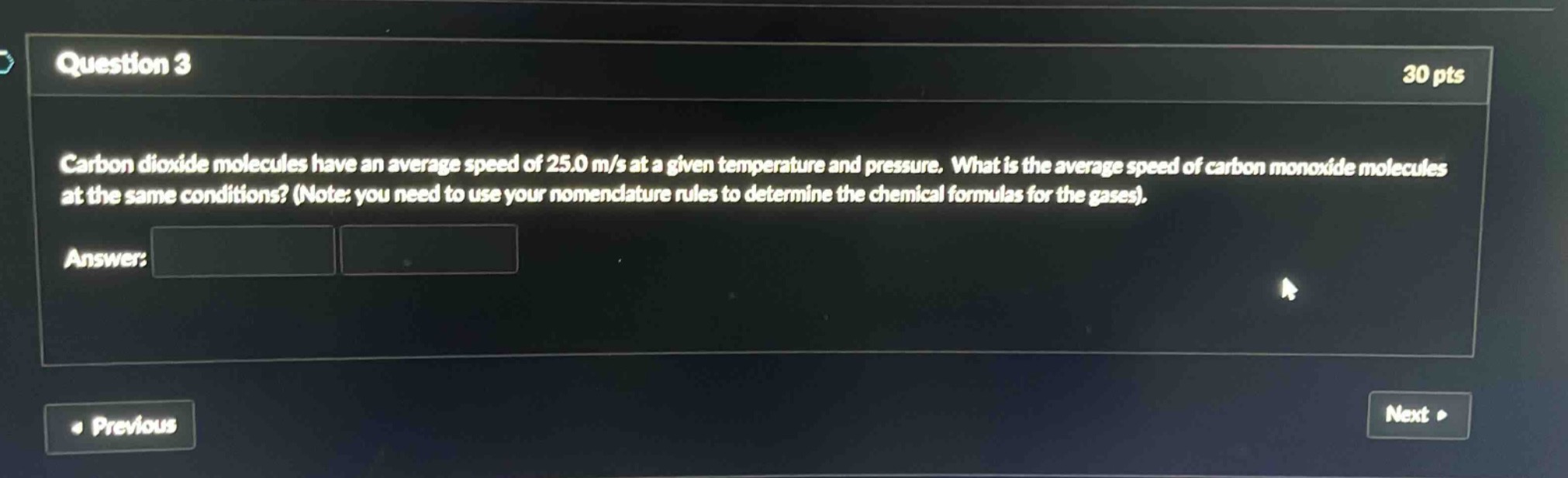
question 3\n30 pts\ncarbon dioxide molecules have an average speed of 25.0 m/s at a given temperature and pressure. what is the average speed of carbon monoxide molecules at the same conditions? (note: you need to use your nomenclature rules to determine the chemical formulas for the gases).\nanswer:
Answer
Explanation:
Step1: Determine chemical formulas
The formula for carbon - dioxide is $CO_2$ and for carbon - monoxide is $CO$.
Step2: Calculate molar masses
The molar mass of $CO_2$, $M_{CO_2}=(12.01 + 2\times16.00)\ g/mol=44.01\ g/mol$. The molar mass of $CO$, $M_{CO}=(12.01+16.00)\ g/mol = 28.01\ g/mol$.
Step3: Apply Graham's law of effusion
Graham's law states that $\frac{v_1}{v_2}=\sqrt{\frac{M_2}{M_1}}$, where $v_1$ and $v_2$ are the average speeds of two gases and $M_1$ and $M_2$ are their molar masses. Let $v_1$ be the speed of $CO$ and $v_2$ be the speed of $CO_2$. Then $v_1 = v_2\sqrt{\frac{M_{CO_2}}{M_{CO}}}$.
Step4: Substitute values
Given $v_2 = 25.0\ m/s$, $M_{CO_2}=44.01\ g/mol$ and $M_{CO}=28.01\ g/mol$. So $v_1=25.0\ m/s\times\sqrt{\frac{44.01}{28.01}}\approx25.0\ m/s\times1.25 = 31.25\ m/s$.
Answer:
$31.25\ m/s$