question 1-6\nwhich formula represents a polar molecule containing polar covalent bonds?\no h₂o\no cl₂\no…
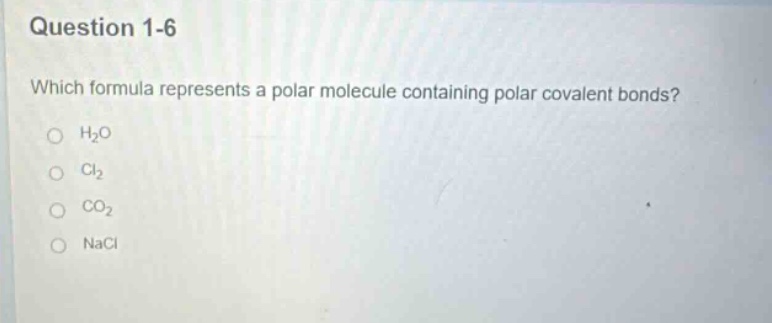
question 1-6\nwhich formula represents a polar molecule containing polar covalent bonds?\no h₂o\no cl₂\no co₂\no nacl
Answer
Brief Explanations:
- For (H_2O): Oxygen is more electronegative than hydrogen. The (O - H) bonds are polar covalent. The bent molecular geometry of (H_2O) means the bond - dipoles do not cancel out, making the molecule polar.
- For (Cl_2): The bond is between two identical chlorine atoms. The electronegativity difference is zero, so the bond is non - polar covalent, and the molecule is non - polar.
- For (CO_2): The (C=O) bonds are polar covalent due to the electronegativity difference between carbon and oxygen. However, the linear geometry of (CO_2) causes the bond - dipoles to cancel out, resulting in a non - polar molecule.
- For (NaCl): It is an ionic compound, not a covalent compound.
Answer:
A. (H_2O)