question 1(multiple choice worth 3 points)\n(07.06 mc)\na chemical equilibrium between gaseous reactants and…
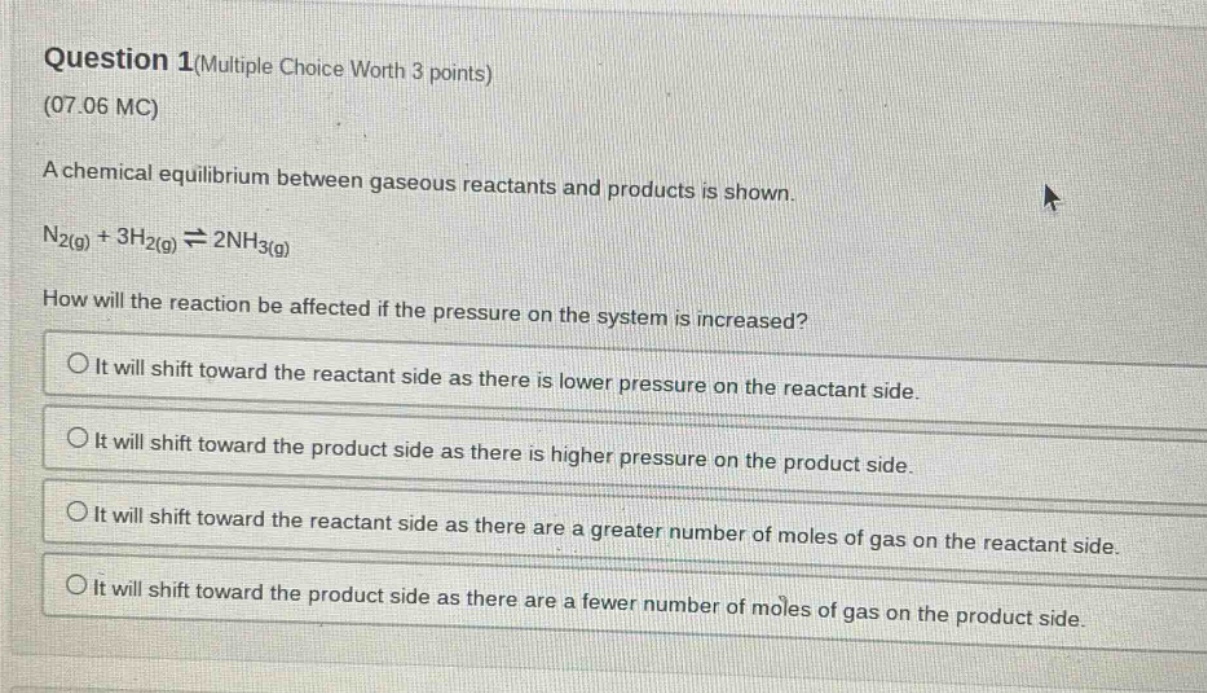
question 1(multiple choice worth 3 points)\n(07.06 mc)\na chemical equilibrium between gaseous reactants and products is shown.\nn₂(g) + 3h₂(g) ⇌ 2nh₃(g)\nhow will the reaction be affected if the pressure on the system is increased?\nit will shift toward the reactant side as there is lower pressure on the reactant side.\nit will shift toward the product side as there is higher pressure on the product side.\nit will shift toward the reactant side as there are a greater number of moles of gas on the reactant side.\nit will shift toward the product side as there are a fewer number of moles of gas on the product side.
Answer
Explanation:
Step1: Recall Le - Chatelier's principle
When pressure is increased in a gaseous equilibrium, the reaction shifts to the side with fewer moles of gas.
Step2: Count moles of gas on each side
On the reactant side, $n_{reactants}=1 + 3=4$ moles of gas ($1$ mole of $N_2$ and $3$ moles of $H_2$). On the product side, $n_{products}=2$ moles of $NH_3$.
Step3: Determine the shift
Since there are fewer moles of gas on the product side, when pressure is increased, the reaction will shift towards the product side.
Answer:
It will shift toward the product side as there are a fewer number of moles of gas on the product side.