question 5(multiple choice worth 3 points)\n(07.06 mc)\nwhat stress will shift the following equilibrium…
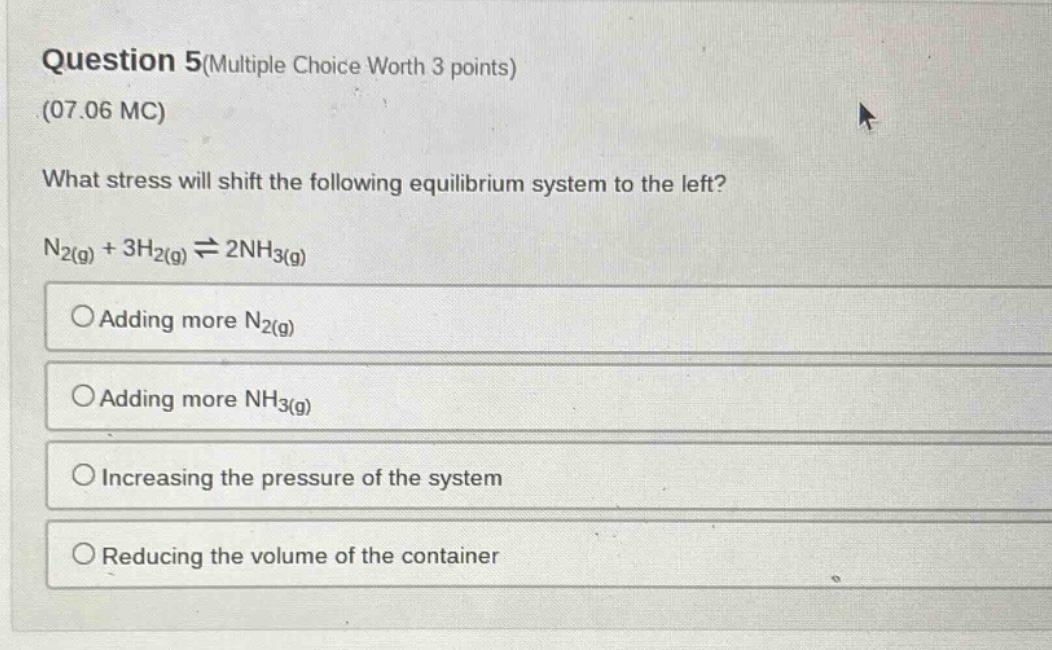
question 5(multiple choice worth 3 points)\n(07.06 mc)\nwhat stress will shift the following equilibrium system to the left?\nn₂(g) + 3h₂(g) ⇌ 2nh₃(g)\n○adding more n₂(g)\n○adding more nh₃(g)\n○increasing the pressure of the system\n○reducing the volume of the container
Answer
Explanation:
Step1: Recall Le - Chatelier's principle
Le - Chatelier's principle states that a system at equilibrium will shift to counteract a stress applied to it.
Step2: Analyze adding more reactant
Adding more $\ce{N2(g)}$ (a reactant) will shift the equilibrium to the right to consume the added $\ce{N2}$.
Step3: Analyze adding more product
Adding more $\ce{NH3(g)}$ (a product) will cause the system to shift to the left to consume the added $\ce{NH3}$ and re - establish equilibrium.
Step4: Analyze pressure changes
For the reaction $\ce{N2(g)}+3\ce{H2(g)}\rightleftharpoons2\ce{NH3(g)}$, there are 4 moles of gas on the left - hand side (1 mole of $\ce{N2}$ and 3 moles of $\ce{H2}$) and 2 moles of gas on the right - hand side. Increasing the pressure (or reducing the volume which is equivalent to increasing pressure) will shift the equilibrium to the side with fewer moles of gas, which is the right side in this case.
Answer:
Adding more $\ce{NH3(g)}$