question 1 (6 points)\na compound containing carbon, hydrogen, and oxygen was found to contain 29.6% carbon…
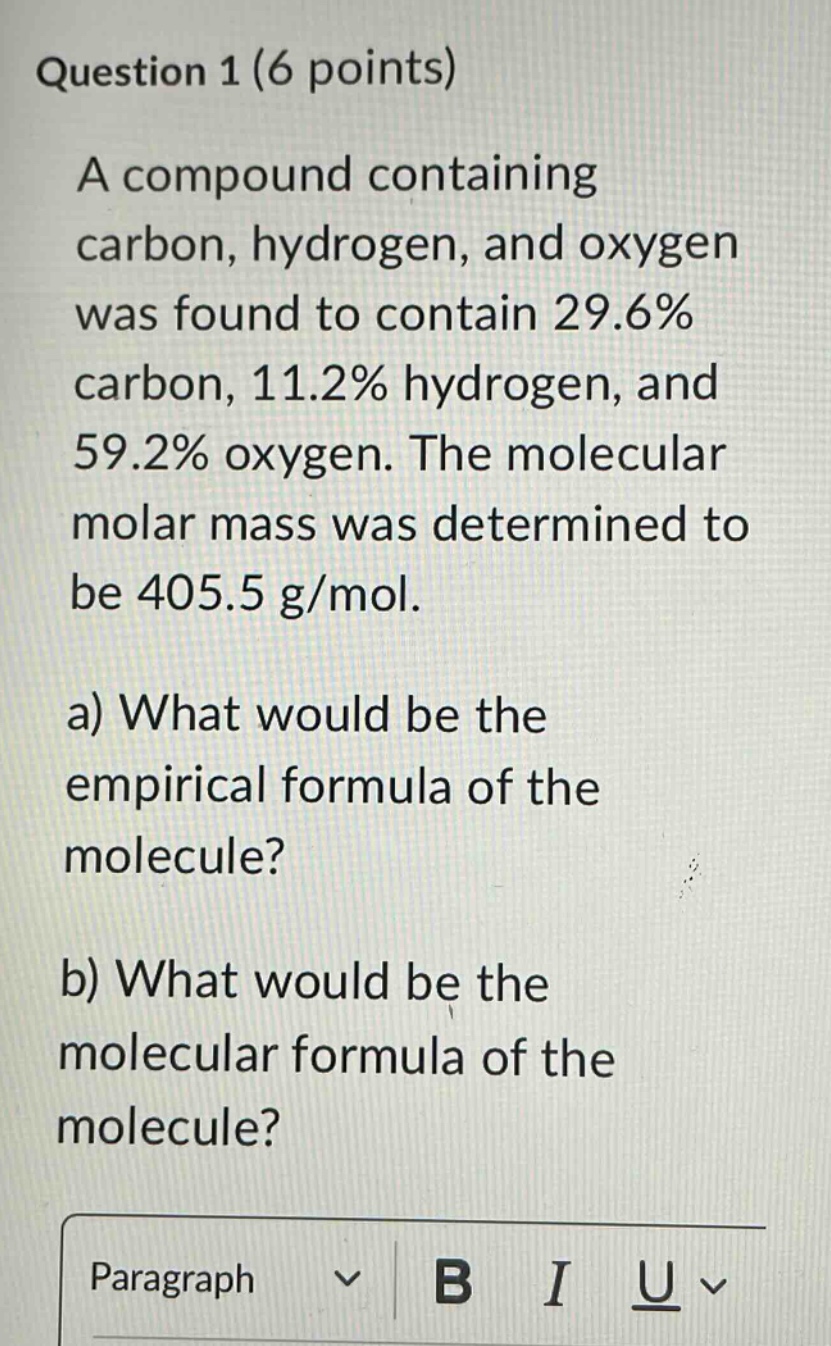
question 1 (6 points)\na compound containing carbon, hydrogen, and oxygen was found to contain 29.6% carbon, 11.2% hydrogen, and 59.2% oxygen. the molecular molar mass was determined to be 405.5 g/mol.\na) what would be the empirical formula of the molecule?\nb) what would be the molecular formula of the molecule?
Answer
Explanation:
Step1: Assume 100g of the compound
If we assume 100g of the compound, then we have 29.6g of carbon, 11.2g of hydrogen, and 59.2g of oxygen.
Step2: Calculate the number of moles of each element
The molar - mass of carbon (C) is (M_{C}=12.01g/mol), hydrogen (H) is (M_{H}=1.01g/mol), and oxygen (O) is (M_{O}=16.00g/mol). The number of moles of carbon (n_{C}=\frac{29.6g}{12.01g/mol}\approx2.465mol). The number of moles of hydrogen (n_{H}=\frac{11.2g}{1.01g/mol}\approx11.09mol). The number of moles of oxygen (n_{O}=\frac{59.2g}{16.00g/mol}=3.7mol).
Step3: Find the mole - ratio of the elements
Divide each number of moles by the smallest number of moles ((n_{C} = 2.465mol)). For carbon: (\frac{2.465mol}{2.465mol}=1). For hydrogen: (\frac{11.09mol}{2.465mol}\approx4.5). For oxygen: (\frac{3.7mol}{2.465mol}\approx1.5). Multiply each ratio by 2 to get whole - numbers. So the empirical formula has a ratio of (C:H:O = 2:9:3). The empirical formula is (C_{2}H_{9}O_{3}).
Step4: Calculate the empirical formula mass
The empirical formula mass (M_{empirical}=(2\times12.01 + 9\times1.01+3\times16.00)g/mol=(24.02 + 9.09+48.00)g/mol = 81.11g/mol).
Step5: Determine the molecular formula
The molecular formula is a multiple (n) of the empirical formula, where (n=\frac{M_{molecular}}{M_{empirical}}). (n=\frac{405.5g/mol}{81.11g/mol}\approx5). The molecular formula is ((C_{2}H_{9}O_{3}){5}=C{10}H_{45}O_{15}).
Answer:
a) (C_{2}H_{9}O_{3}) b) (C_{10}H_{45}O_{15})