what reactant(s) can be used to distinguish $agno_{3}$ and $hno_{3}$?\n\na $pb(no_{3})_{2}$\nb $ki$\nc…
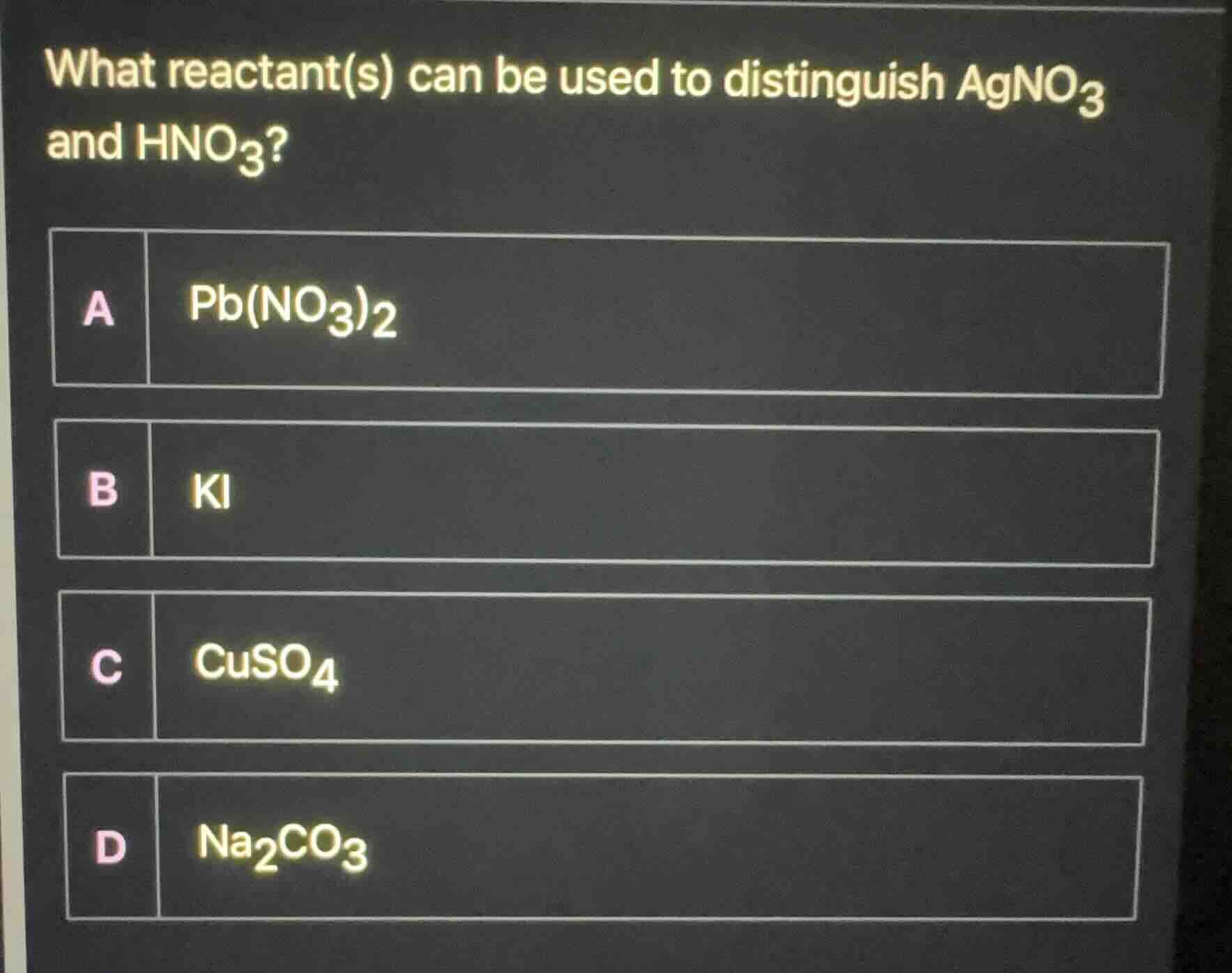
what reactant(s) can be used to distinguish $agno_{3}$ and $hno_{3}$?\n\na $pb(no_{3})_{2}$\nb $ki$\nc $cuso_{4}$\nd $na_{2}co_{3}$
Answer
Explanation:
Step1: Analyze the reaction with KI
Potassium iodide ($KI$) reacts with silver nitrate ($AgNO_{3}$) to form a yellow precipitate of silver iodide ($AgI$). $$AgNO_{3}(aq) + KI(aq) \rightarrow AgI(s) + KNO_{3}(aq)$$
Step2: Analyze KI reaction with $HNO_{3}$
Potassium iodide does not form a precipitate with nitric acid ($HNO_{3}$) under standard conditions.
Step3: Analyze the reaction with $Na_{2}CO_{3}$
Sodium carbonate ($Na_{2}CO_{3}$) reacts with $AgNO_{3}$ to form a grayish-white precipitate of silver carbonate ($Ag_{2}CO_{3}$). $$2AgNO_{3}(aq) + Na_{2}CO_{3}(aq) \rightarrow Ag_{2}CO_{3}(s) + 2NaNO_{3}(aq)$$
Step4: Analyze $Na_{2}CO_{3}$ reaction with $HNO_{3}$
Sodium carbonate reacts with $HNO_{3}$ to produce carbon dioxide gas bubbles (effervescence). $$Na_{2}CO_{3}(aq) + 2HNO_{3}(aq) \rightarrow 2NaNO_{3}(aq) + H_{2}O(l) + CO_{2}(g)$$
Step5: Evaluate other options
$Pb(NO_{3}){2}$ and $CuSO{4}$ do not provide distinct observable differences for both substances.
Answer:
B. KI D. Na2CO3