the reaction 2icl(s)⇌i₂(s)+cl₂(g) is at equilibrium. which change will increase the yield of cl₂?\nremoving…
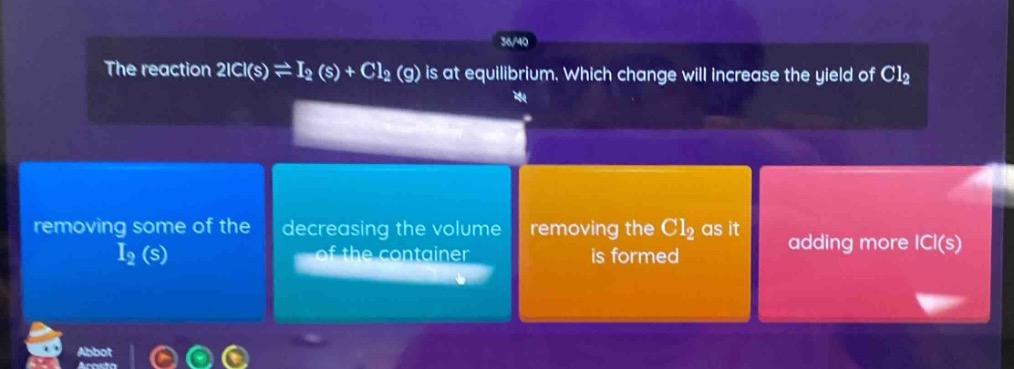
the reaction 2icl(s)⇌i₂(s)+cl₂(g) is at equilibrium. which change will increase the yield of cl₂?\nremoving some of the i₂(s)\ndecreasing the volume of the container\nremoving the cl₂ as it is formed\nadding more icl(s)
Answer
Answer:
C. removing the $\mathrm{Cl_2}$ as it is formed
Explanation:
Step1: Le - Chatelier's principle
According to Le - Chatelier's principle, when a system at equilibrium is subjected to a change, the equilibrium will shift to counteract the change.
Step2: Analyze option A
Removing some of the $\mathrm{I_2(s)}$ (a solid) does not affect the equilibrium position because the concentration of a solid is considered constant in an equilibrium expression.
Step3: Analyze option B
Decreasing the volume of the container increases the pressure. For the reaction $2\mathrm{ICl(s)}\rightleftharpoons\mathrm{I_2(s)}+\mathrm{Cl_2(g)}$, since there is 1 mole of gas on the product side and no gas on the reactant side, increasing the pressure will shift the equilibrium to the side with fewer moles of gas (left - hand side), decreasing the yield of $\mathrm{Cl_2}$.
Step4: Analyze option C
Removing $\mathrm{Cl_2}$ as it is formed decreases the concentration of $\mathrm{Cl_2}$. To counteract this decrease, the equilibrium will shift to the right, increasing the yield of $\mathrm{Cl_2}$.
Step5: Analyze option D
Adding more $\mathrm{ICl(s)}$ (a solid) does not affect the equilibrium position as the concentration of a solid is constant in the equilibrium expression.