in which reaction are electrons transferred from one reactant to another reactant?\na) 2ca(s) + o₂ (g) →…
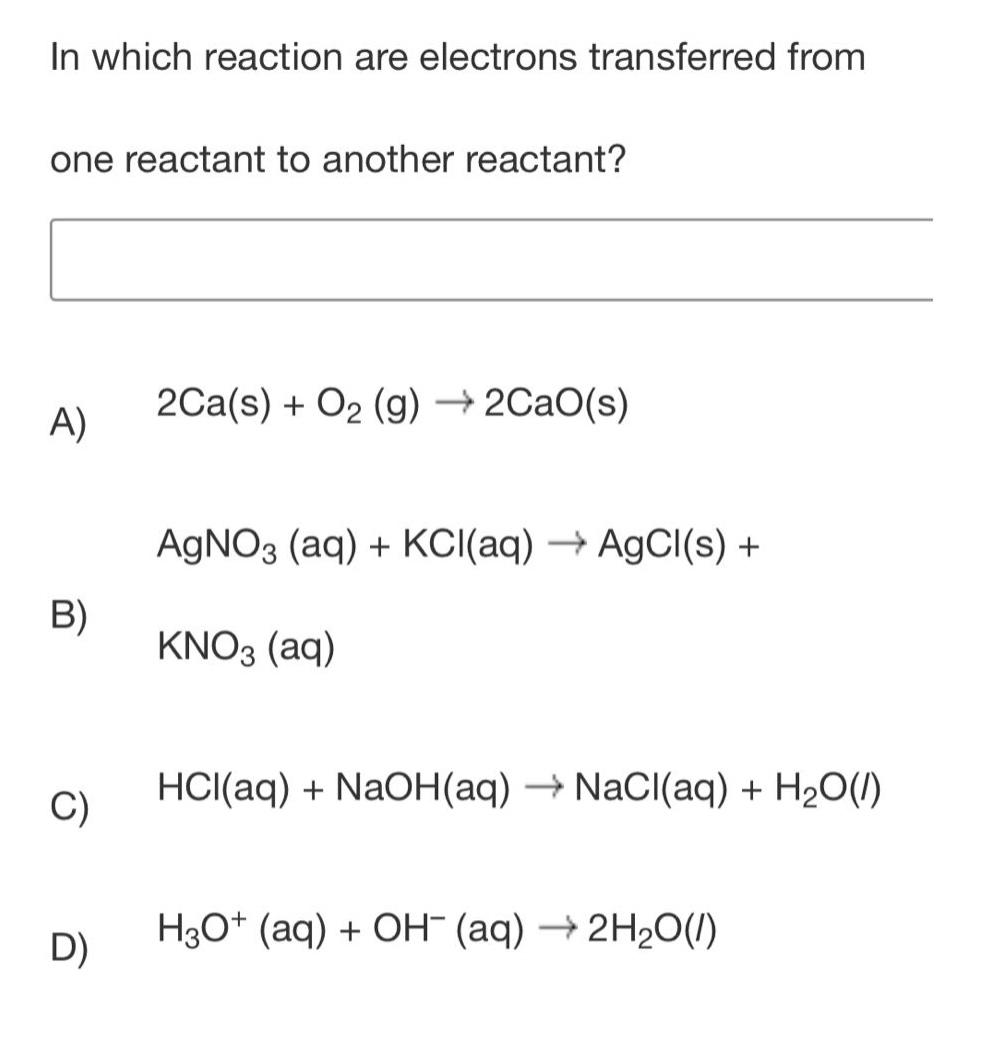
in which reaction are electrons transferred from one reactant to another reactant?\na) 2ca(s) + o₂ (g) → 2cao(s)\nb) agno₃ (aq) + kcl(aq) → agcl(s) + kno₃ (aq)\nc) hcl(aq) + naoh(aq) → nacl(aq) + h₂o(l)\nd) h₃o⁺ (aq) + oh⁻ (aq) → 2h₂o(l)
Answer
Explanation:
Step1: Identify redox reactions
Redox reactions involve electron - transfer. Oxidation is loss of electrons and reduction is gain of electrons.
Step2: Analyze option A
In $2Ca(s)+O_2(g)\rightarrow2CaO(s)$, calcium ($Ca$) goes from an oxidation state of 0 to +2 (loses electrons, oxidation) and oxygen ($O$) goes from 0 to - 2 (gains electrons, reduction). This is a redox reaction with electron - transfer.
Step3: Analyze option B
The reaction $AgNO_3(aq)+KCl(aq)\rightarrow AgCl(s)+KNO_3(aq)$ is a double - displacement reaction. There is no change in oxidation states of the elements involved. No electron - transfer occurs.
Step4: Analyze option C
The reaction $HCl(aq)+NaOH(aq)\rightarrow NaCl(aq)+H_2O(l)$ is a neutralization reaction. There is no change in oxidation states of the elements. No electron - transfer occurs.
Step5: Analyze option D
The reaction $H_3O^+(aq)+OH^-(aq)\rightarrow2H_2O(l)$ is an acid - base reaction. There is no change in oxidation states of the elements. No electron - transfer occurs.
Answer:
A. $2Ca(s)+O_2(g)\rightarrow2CaO(s)$