a reaction occurs when the bonds of the reacting compounds are broken and new bonds are formed. synthesis…
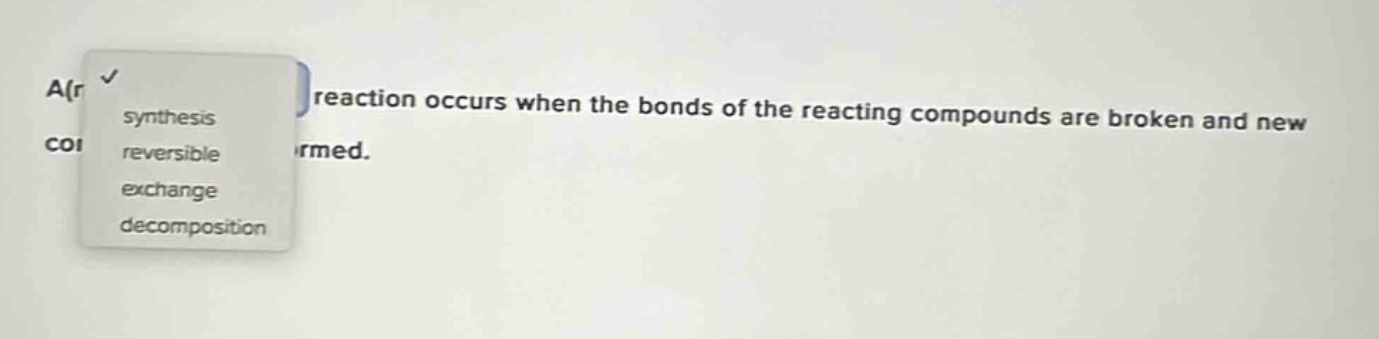
a reaction occurs when the bonds of the reacting compounds are broken and new bonds are formed. synthesis reversible exchange decomposition
Answer
Answer:
No correct option provided in the question. But the description matches a chemical reaction in general. Among the options given, a synthesis reaction involves the combination of substances to form a new compound (bonds are formed), a reversible reaction can go in both forward and reverse directions, an exchange reaction involves the exchange of ions or groups between reactants, and a decomposition reaction involves a compound breaking down into simpler substances (bonds are broken). If we assume the best - fit based on the description of bond - breaking and new bond - forming, it could be a general chemical reaction concept and not specifically one of these types in a strict sense. But if we have to choose from the given options, none of them precisely capture the general idea of bond - breaking and new bond - forming as a whole.
Explanation:
Step1: Analyze synthesis reaction
A synthesis reaction mainly focuses on formation of new substances from simpler ones, not emphasizing bond - breaking as the main aspect.
Step2: Analyze reversible reaction
A reversible reaction is about the directionality of the reaction, not directly related to the core concept of bond - breaking and new bond - forming described.
Step3: Analyze exchange reaction
An exchange reaction is about the swapping of components, not fully encompassing the general idea of bond - breaking and new bond - forming.
Step4: Analyze decomposition reaction
A decomposition reaction focuses on the breakdown of a compound, mainly bond - breaking, not new bond - forming in the context of the overall description.