read the passage and answer the following question. which atom or ion listed on the table has the greatest…
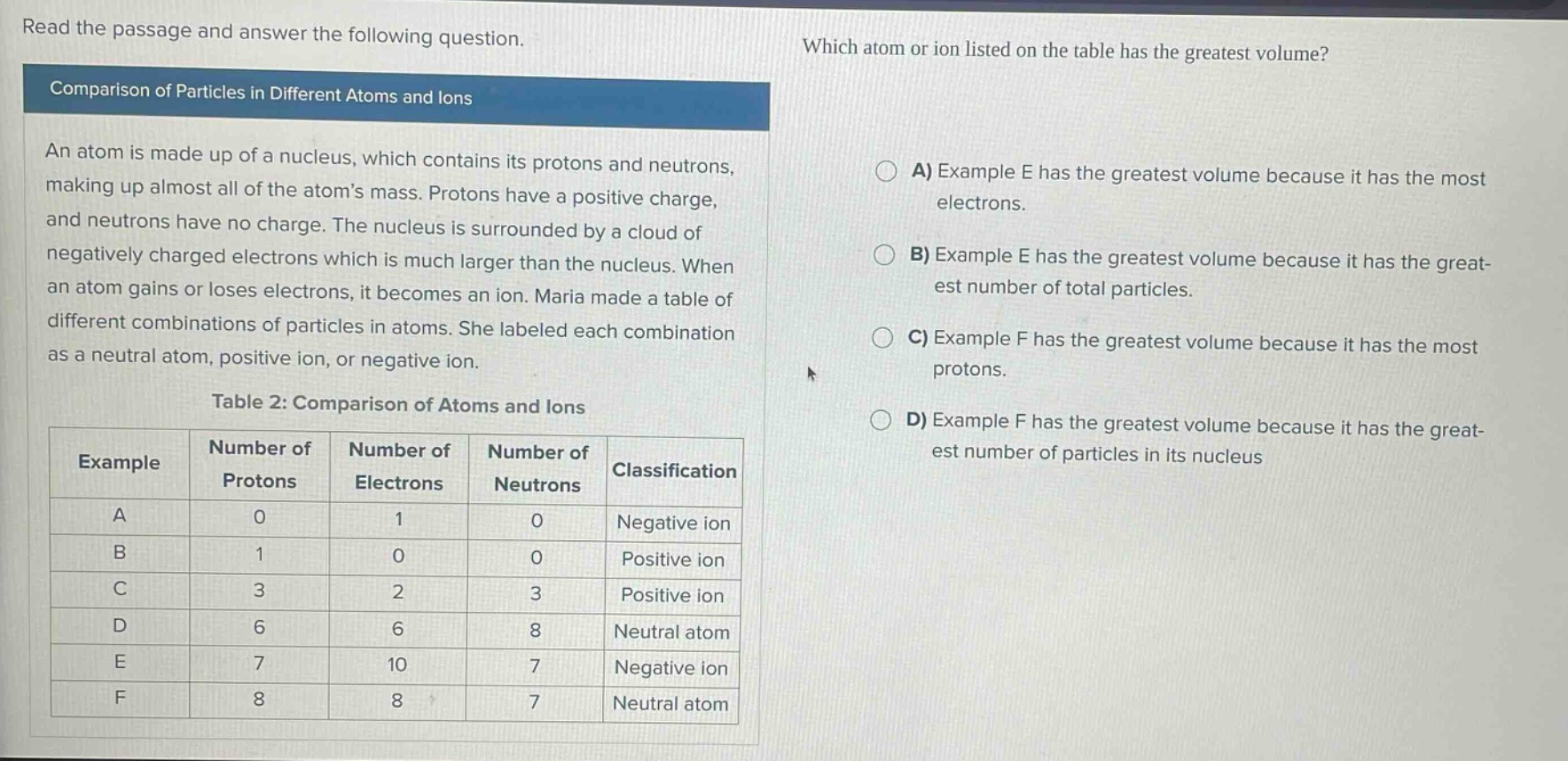
read the passage and answer the following question. which atom or ion listed on the table has the greatest volume? comparison of particles in different atoms and ions an atom is made up of a nucleus, which contains its protons and neutrons, making up almost all of the atoms mass. protons have a positive charge, and neutrons have no charge. the nucleus is surrounded by a cloud of negatively charged electrons which is much larger than the nucleus. when an atom gains or loses electrons, it becomes an ion. maria made a table of different combinations of particles in atoms. she labeled each combination as a neutral atom, positive ion, or negative ion. table 2: comparison of atoms and ions example number of protons number of electrons number of neutrons classification a 0 1 0 negative ion b 1 0 0 positive ion c 3 2 3 positive ion d 6 6 8 neutral atom e 7 10 7 negative ion f 8 8 7 neutral atom a) example e has the greatest volume because it has the most electrons. b) example e has the greatest volume because it has the greatest number of total particles. c) example f has the greatest volume because it has the most protons. d) example f has the greatest volume because it has the greatest number of particles in its nucleus
Answer
Explanation:
Step1: Recall atomic volume concept
The volume of an atom or ion is mainly determined by the electron - cloud. The more electrons an atom or ion has, the larger its electron - cloud and thus the larger its volume.
Step2: Analyze each option
- Option A: Example E has 10 electrons, which is the highest number of electrons among the given examples. Since the volume is mainly determined by the electron - cloud, the one with more electrons has a larger volume.
- Option B: The total number of particles (protons + neutrons+ electrons) is not the determining factor for volume. The volume is mainly due to the electron - cloud.
- Option C: The number of protons mainly affects the nuclear charge and atomic number, not the volume directly.
- Option D: The number of particles in the nucleus (protons + neutrons) does not determine the volume. The volume is mainly from the electron - cloud.
Answer:
A. Example E has the greatest volume because it has the most electrons.