reinforcement: the chemistry of life\n\n1. neutral subatomic particles found in the nucleus of an atom: \n2…
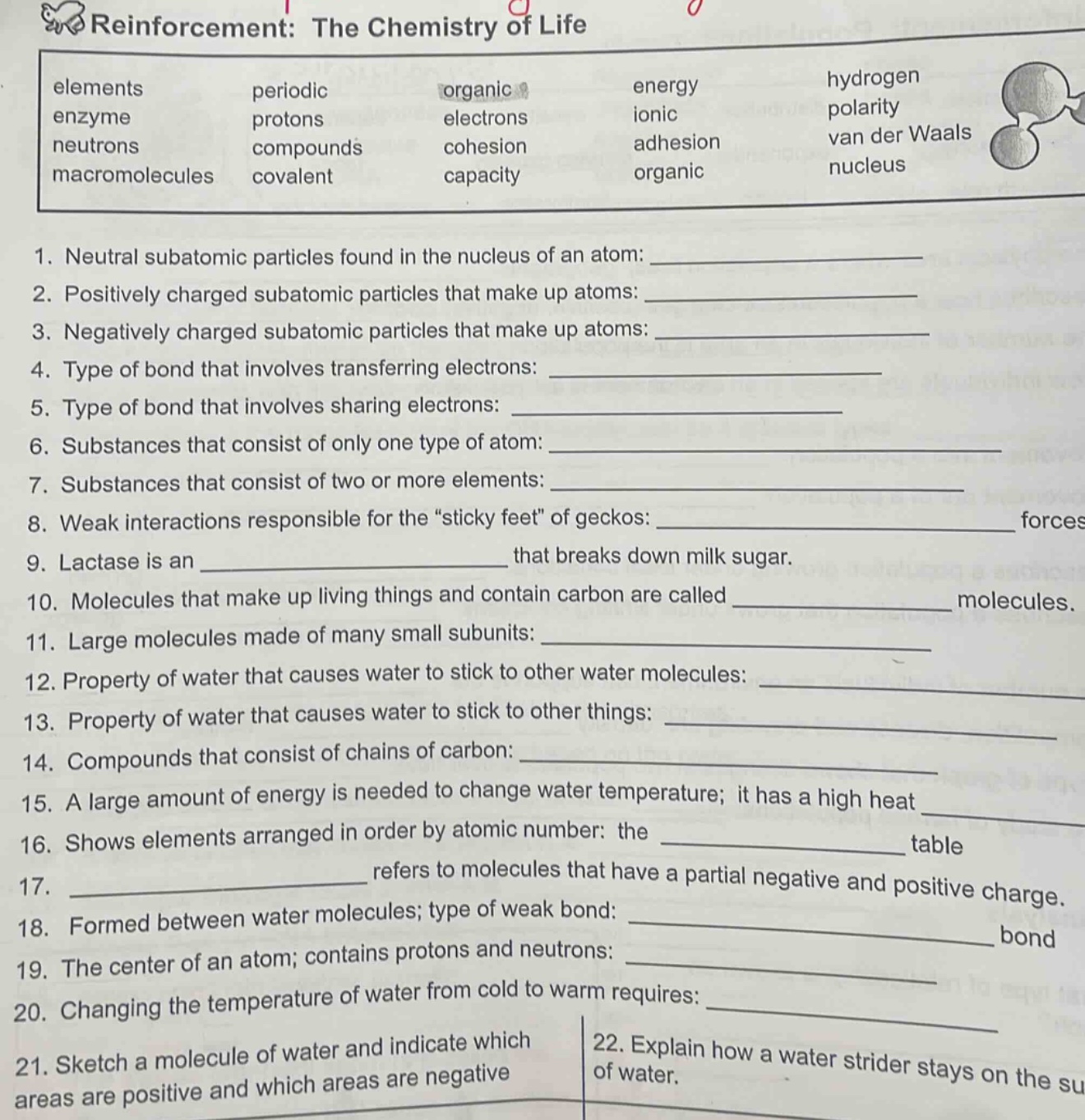
reinforcement: the chemistry of life\n\n1. neutral subatomic particles found in the nucleus of an atom: \n2. positively charged subatomic particles that make up atoms: \n3. negatively charged subatomic particles that make up atoms: \n4. type of bond that involves transferring electrons: \n5. type of bond that involves sharing electrons: \n6. substances that consist of only one type of atom: \n7. substances that consist of two or more elements: \n8. weak interactions responsible for the \sticky feet\ of geckos: forces\n9. lactase is an that breaks down milk sugar.\n10. molecules that make up living things and contain carbon are called molecules.\n11. large molecules made of many small subunits: \n12. property of water that causes water to stick to other water molecules: \n13. property of water that causes water to stick to other things: \n14. compounds that consist of chains of carbon: \n15. a large amount of energy is needed to change water temperature; it has a high heat \n16. shows elements arranged in order by atomic number: the table\n17. refers to molecules that have a partial negative and positive charge.\n18. formed between water molecules; type of weak bond: bond\n19. the center of an atom; contains protons and neutrons: \n20. changing the temperature of water from cold to warm requires: \n21. sketch a molecule of water and indicate which areas are positive and which areas are negative\n22. explain how a water strider stays on the surface of water.
Answer
Brief Explanations:
- Neutrons are neutral sub - atomic particles in the nucleus.
- Protons are positively charged sub - atomic particles.
- Electrons are negatively charged sub - atomic particles.
- Ionic bonds involve electron transfer.
- Covalent bonds involve electron sharing.
- Elements consist of one type of atom.
- Compounds consist of two or more elements.
- Van der Waals forces are responsible for gecko's "sticky feet".
- Lactase is an enzyme for breaking down milk sugar.
- Organic molecules in living things contain carbon.
- Macromolecules are made of many small subunits.
- Cohesion is water sticking to water molecules.
- Adhesion is water sticking to other things.
- Organic compounds can have carbon chains.
- Water has a high heat capacity.
- The periodic table arranges elements by atomic number.
- Polarity refers to partial charges in a molecule.
- Hydrogen bonds are between water molecules.
- The nucleus is the center of an atom with protons and neutrons.
- Changing water temperature requires energy.
- In a water molecule, oxygen is partially negative and hydrogens are partially positive.
- A water strider stays on water due to surface tension from hydrogen bonds.
Answer:
- neutrons
- protons
- electrons
- ionic
- covalent
- elements
- compounds
- van der Waals
- enzyme
- organic
- macromolecules
- cohesion
- adhesion
- organic
- capacity
- periodic
- polarity
- hydrogen
- nucleus
- energy
- Sketch: Oxygen is partially negative, hydrogens are partially positive.
- Due to surface tension from hydrogen bonds.