ring of truth - phillip morrison\nthere are several segments that make up this video. please note the…
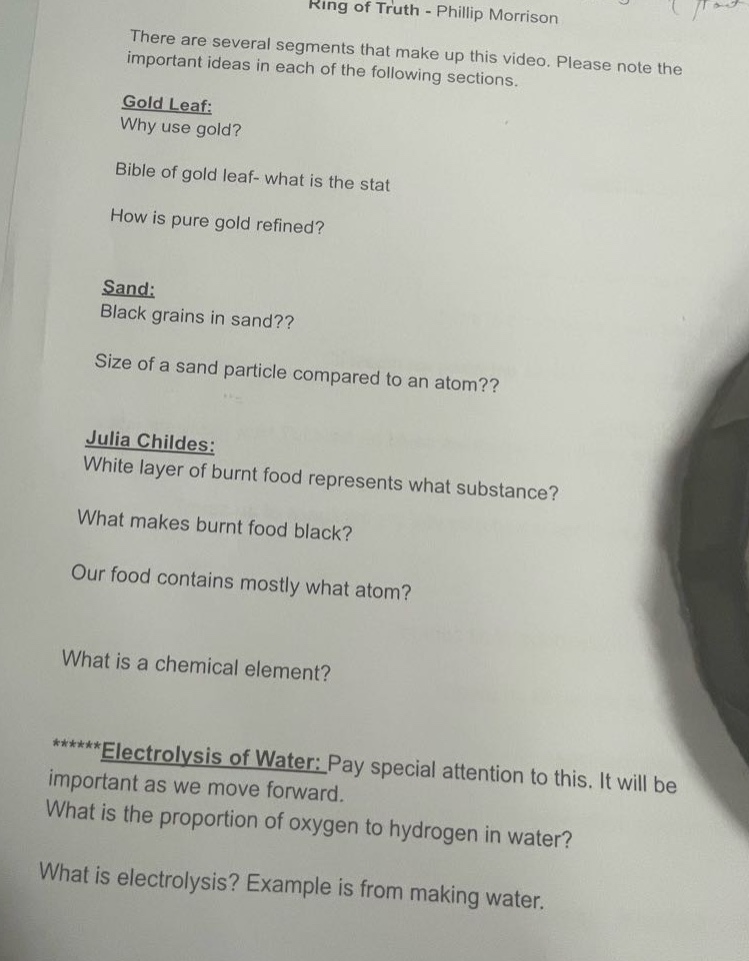
ring of truth - phillip morrison\nthere are several segments that make up this video. please note the important ideas in each of the following sections.\ngold leaf:\nwhy use gold?\nbible of gold leaf - what is the stat\nhow is pure gold refined?\nsand:\nblack grains in sand??\nsize of a sand particle compared to an atom??\njulia childes:\nwhite layer of burnt food represents what substance?\nwhat makes burnt food black?\nour food contains mostly what atom?\nwhat is a chemical element?\n******electrolysis of water: pay special attention to this. it will be important as we move forward.\nwhat is the proportion of oxygen to hydrogen in water?\nwhat is electrolysis? example is from making water.
Answer
Brief Explanations:
- Gold Leaf: Gold is used for its malleability, resistance to corrosion etc. The "Bible of gold leaf" is unclear without more context. Pure gold is refined through methods like electrolytic refining.
- Sand: Black grains in sand can be minerals like magnetite. A sand - particle is much larger than an atom.
- Julia Childes: The white layer of burnt food could be ash (inorganic salts). Burnt food is black due to carbonization. Food mostly contains carbon atoms. A chemical element is a pure substance made of only one type of atom.
- Electrolysis of Water: The proportion of oxygen to hydrogen in water is 1:2 by number of atoms. Electrolysis is the decomposition of a substance by an electric current, and in water, it splits water into hydrogen and oxygen gases.
Answer:
- Reasons for using gold: Malleability, corrosion - resistance. Stat of "Bible of gold leaf" is unclear. Pure gold refining method: Electrolytic refining.
- Black grains in sand: Minerals like magnetite. Sand - particle vs atom size: Sand - particle is much larger.
- White layer of burnt food: Ash (inorganic salts). What makes burnt food black: Carbonization. Atom in food: Carbon. Chemical element: Pure substance of one - type atom.
- Proportion of oxygen to hydrogen in water: 1:2. Electrolysis: Decomposition by electric current, e.g., splitting water into H₂ and O₂.