a sample is characterized as non-conductive in any state, has a low melting point, and excellent solubility…
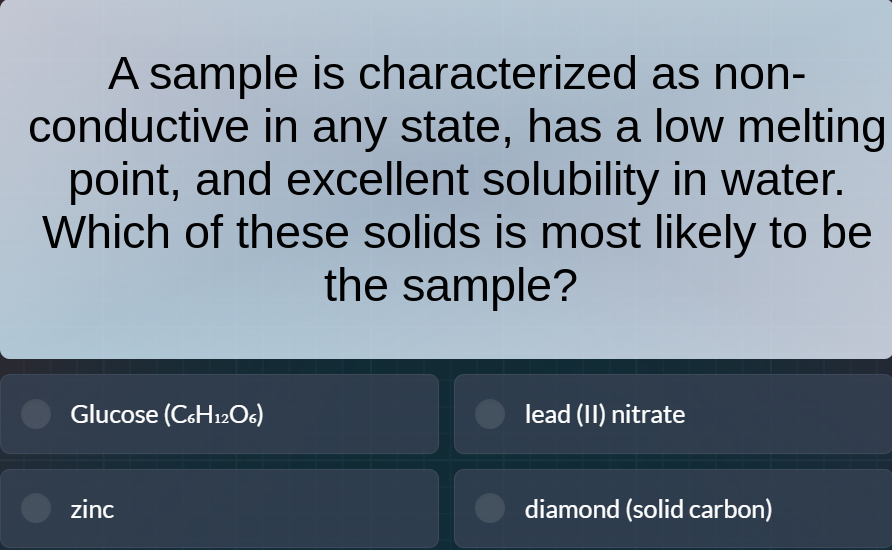
a sample is characterized as non-conductive in any state, has a low melting point, and excellent solubility in water. which of these solids is most likely to be the sample?\nglucose ($c_6h_{12}o_6$)\nlead (ii) nitrate\nzinc\ndiamond (solid carbon)
Answer
Brief Explanations:
- Glucose (C₆H₁₂O₆): It is a molecular covalent solid. Molecular solids have low melting points, do not conduct electricity in any state (no free ions/electrons), and polar glucose molecules are highly soluble in polar water due to hydrogen bonding.
- Lead (II) nitrate: This is an ionic solid. It has a high melting point, and while solid lead(II) nitrate does not conduct, its aqueous solution or molten form does conduct electricity, which contradicts the "non-conductive in any state" trait.
- Zinc: This is a metallic solid. Metals conduct electricity in both solid and molten states, which violates the given property.
- Diamond: This is a network covalent solid. It has an extremely high melting point and is insoluble in water, so it does not match the description.
Answer:
Glucose (C₆H₁₂O₆)