for a science project, janet performs four experiments that are supposed to show a chemical reaction. she…
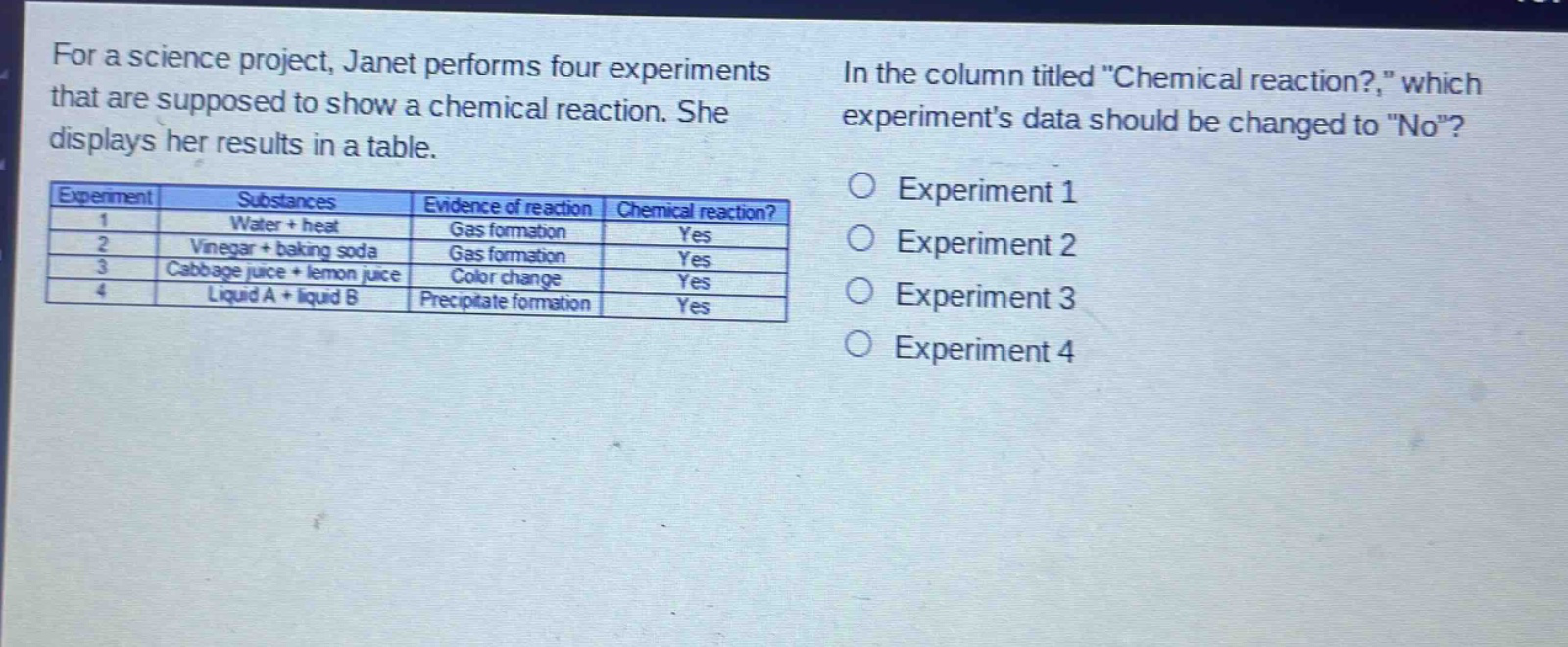
for a science project, janet performs four experiments that are supposed to show a chemical reaction. she displays her results in a table.\n| experiment | substances | evidence of reaction | chemical reaction? |\n| ---- | ---- | ---- | ---- |\n| 1 | water + heat | gas formation | yes |\n| 2 | vinegar + baking soda | gas formation | yes |\n| 3 | cabbage juice + lemon juice | color change | yes |\n| 4 | liquid a + liquid b | precipitate formation | yes |\nin the column titled \chemical reaction?\, which experiments data should be changed to \no\?\n○ experiment 1\n○ experiment 2\n○ experiment 3\n○ experiment 4
Answer
Explanation:
Step1: Recall chemical - physical change concepts
A chemical reaction results in the formation of new substances with different chemical properties. A physical change only changes the state or appearance of a substance without forming new substances.
Step2: Analyze Experiment 1
Heating water to form gas (steam) is a physical change. Water changes from liquid to gas state, but it is still water ($H_2O$). There is no new substance formed. Gas formation in this case is due to a change in state, not a chemical reaction.
Step3: Analyze Experiment 2
Vinegar (acetic acid, $CH_3COOH$) and baking soda (sodium bicarbonate, $NaHCO_3$) react to form carbon dioxide gas, water and a salt (sodium acetate, $CH_3COONa$). This is a chemical reaction.
Step4: Analyze Experiment 3
Cabbage juice is a natural pH - indicator. When lemon juice (acidic) is added to it, a color change occurs due to a chemical reaction between the indicator and the acid.
Step5: Analyze Experiment 4
Precipitate formation usually indicates a chemical reaction where two soluble substances react to form an insoluble product.
Answer:
Experiment 1