c. scl₂\nis scl₂ polar or nonpolar?\nball & stick + labels\nsubmit answer retry entire group 9 more group…
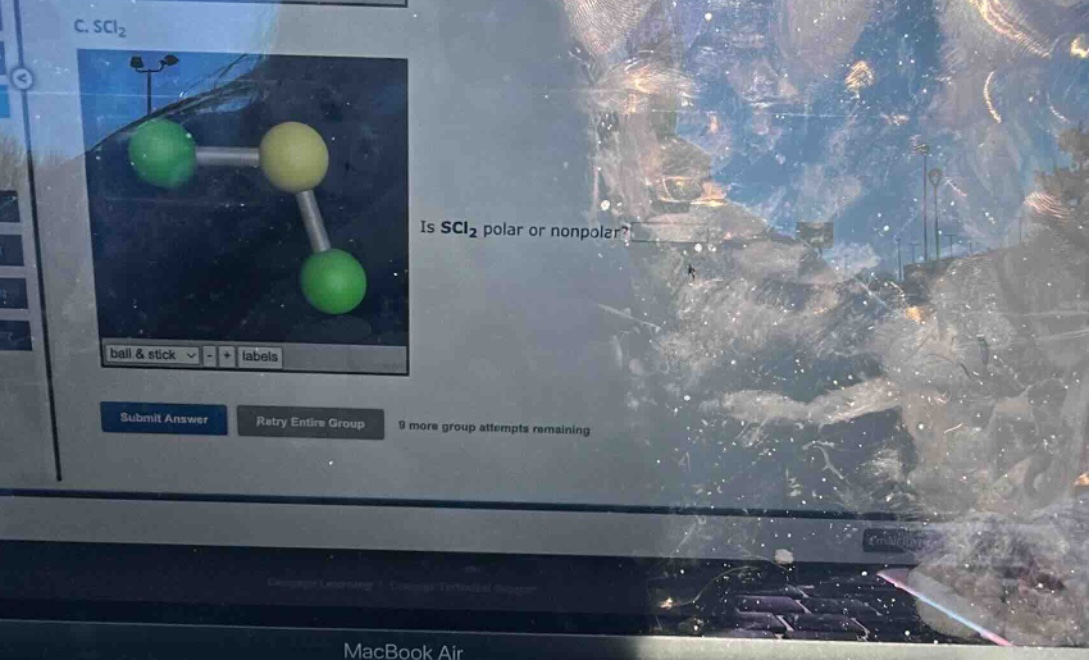
c. scl₂\nis scl₂ polar or nonpolar?\nball & stick + labels\nsubmit answer retry entire group 9 more group attempts remaining
Answer
Brief Explanations:
To determine if Sulfur Dichloride ($SCl_2$) is polar or nonpolar, we need to consider its molecular geometry and the polarity of its bonds.
- Lewis Structure and VSEPR Theory: Sulfur (S) is the central atom bonded to two Chlorine (Cl) atoms. Sulfur has 6 valence electrons, and each Chlorine has 7. The total valence electrons are $6 + 2 \times 7 = 20$. The Lewis structure shows S single-bonded to two Cl atoms, with two lone pairs on the S atom. According to VSEPR theory, the four electron domains (2 bonding pairs, 2 lone pairs) around the central S atom result in a bent or angular molecular geometry.
- Bond Polarity: Chlorine (electronegativity ≈ 3.16) is more electronegative than Sulfur (electronegativity ≈ 2.58). This difference in electronegativity makes the S-Cl bonds polar, with a partial negative charge ($\delta^-$) on Cl and a partial positive charge ($\delta^+$) on S.
- Molecular Polarity: Due to the bent molecular geometry, the individual bond dipoles of the S-Cl bonds do not cancel each other out. The molecule has an asymmetrical distribution of charge, resulting in a net dipole moment. The presence of lone pairs on the sulfur atom also contributes to the overall polarity.
Therefore, $SCl_2$ is a polar molecule.
Answer:
Polar