section 2\nproblems write the answer on the line to the left. show all your work in the\nspace provided.\n1…
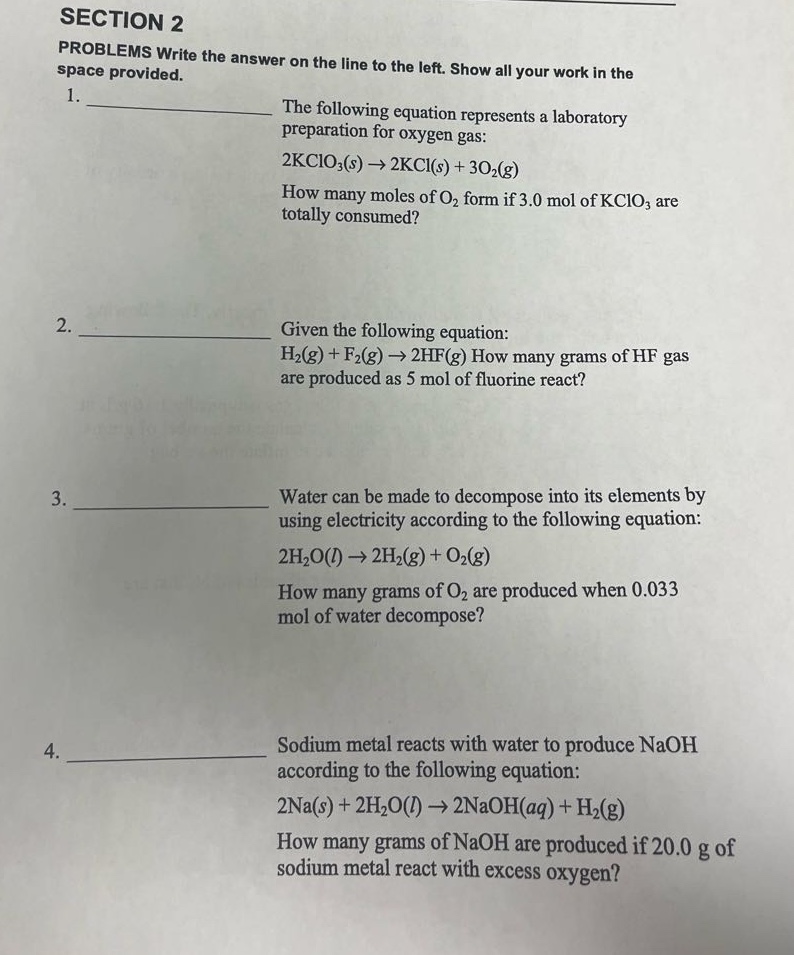
section 2\nproblems write the answer on the line to the left. show all your work in the\nspace provided.\n1. the following equation represents a laboratory\npreparation for oxygen gas:\n2kclo₃(s) → 2kcl(s) + 3o₂(g)\nhow many moles of o₂ form if 3.0 mol of kclo₃ are\ntotally consumed?\n2. given the following equation:\nh₂(g) + f₂(g) → 2hf(g) how many grams of hf gas\nare produced as 5 mol of fluorine react?\n3. water can be made to decompose into its elements by\nusing electricity according to the following equation:\n2h₂o(l) → 2h₂(g) + o₂(g)\nhow many grams of o₂ are produced when 0.033\nmol of water decompose?\n4. sodium metal reacts with water to produce naoh\naccording to the following equation:\n2na(s) + 2h₂o(l) → 2naoh(aq) + h₂(g)\nhow many grams of naoh are produced if 20.0 g of\nsodium metal react with excess oxygen?
Answer
Problem 1
Explanation:
Step1: Determine mole ratio
From the equation (2KClO_3(s)\to2KCl(s) + 3O_2(g)), the mole ratio of (KClO_3) to (O_2) is (2:3).
Step2: Calculate moles of (O_2)
Let (x) be the moles of (O_2). Using the ratio (\frac{2}{3}=\frac{3.0}{x}), cross - multiply: (2x = 3\times3.0), so (x=\frac{9.0}{2}=4.5)
Answer:
(4.5) mol
Problem 2
Explanation:
Step1: Determine mole ratio
From the equation (H_2(g)+F_2(g)\to2HF(g)), the mole ratio of (F_2) to (HF) is (1:2). If (n(F_2) = 5) mol, then (n(HF)=2\times5 = 10) mol.
Step2: Calculate mass of (HF)
The molar mass of (HF) is (M(HF)=1 + 19=20) g/mol. Using (m = n\times M), (m(HF)=10\times20 = 200) g
Answer:
(200) g
Problem 3
Explanation:
Step1: Determine mole ratio
From the equation (2H_2O(l)\to2H_2(g)+O_2(g)), the mole ratio of (H_2O) to (O_2) is (2:1). If (n(H_2O)=0.033) mol, then (n(O_2)=\frac{0.033}{2}=0.0165) mol.
Step2: Calculate mass of (O_2)
The molar mass of (O_2) is (M(O_2)=32) g/mol. Using (m=n\times M), (m(O_2)=0.0165\times32 = 0.528) g
Answer:
(0.528) g
Problem 4
Explanation:
Step1: Calculate moles of (Na)
The molar mass of (Na) is (M(Na) = 23) g/mol. (n(Na)=\frac{20.0}{23}) mol.
Step2: Determine mole ratio
From the equation (2Na(s)+2H_2O(l)\to2NaOH(aq)+H_2(g)), the mole ratio of (Na) to (NaOH) is (1:1). So (n(NaOH)=\frac{20.0}{23}) mol.
Step3: Calculate mass of (NaOH)
The molar mass of (NaOH) is (M(NaOH)=40) g/mol. Using (m = n\times M), (m(NaOH)=\frac{20.0}{23}\times40=\frac{800}{23}\approx34.8) g
Answer:
(\approx34.8) g