select the correct answer from each drop - down menu.\na reaction proceeds with 2.72 moles of magnesium…
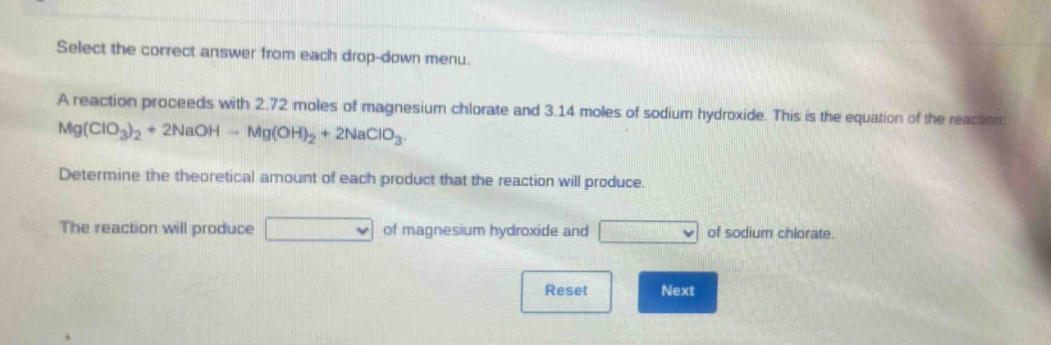
select the correct answer from each drop - down menu.\na reaction proceeds with 2.72 moles of magnesium chlorate and 3.14 moles of sodium hydroxide. this is the equation of the reaction: mg(clo₃)₂ + 2naoh → mg(oh)₂ + 2naclo₃.\ndetermine the theoretical amount of each product that the reaction will produce.\nthe reaction will produce of magnesium hydroxide and of sodium chlorate.
Answer
Explanation:
Step1: Identify the limiting reactant
The mole - ratio of $Mg(ClO_3)_2$ to $NaOH$ in the reaction $Mg(ClO_3)_2 + 2NaOH\rightarrow Mg(OH)_2+2NaClO_3$ is $1:2$. For $Mg(ClO_3)2$: Given $n{Mg(ClO_3)2}=2.72$ moles. The moles of $NaOH$ required for complete reaction of $Mg(ClO_3)2$ is $n{NaOH - required}=2\times n{Mg(ClO_3)2}=2\times2.72 = 5.44$ moles. But we have only $n{NaOH - available}=3.14$ moles. For $NaOH$: The moles of $Mg(ClO_3)2$ required for complete reaction of $NaOH$ is $n{Mg(ClO_3)2 - required}=\frac{n{NaOH - available}}{2}=\frac{3.14}{2}=1.57$ moles. Since $1.57<2.72$, $NaOH$ is the limiting reactant.
Step2: Calculate moles of $Mg(OH)_2$
The mole - ratio of $NaOH$ to $Mg(OH)2$ is $2:1$. Using the proportion $\frac{n{Mg(OH)2}}{n{NaOH}}=\frac{1}{2}$, and $n_{NaOH}=3.14$ moles. So $n_{Mg(OH)2}=\frac{1}{2}\times n{NaOH}=\frac{1}{2}\times3.14 = 1.57$ moles.
Step3: Calculate moles of $NaClO_3$
The mole - ratio of $NaOH$ to $NaClO_3$ is $2:2 = 1:1$. Since $n_{NaOH}=3.14$ moles, $n_{NaClO_3}=n_{NaOH}=3.14$ moles.
Answer:
The reaction will produce 1.57 moles of magnesium hydroxide and 3.14 moles of sodium chlorate.