select the correct answer. which of the following aqueous solutions has the lowest freezing point? a. 1.0 m…
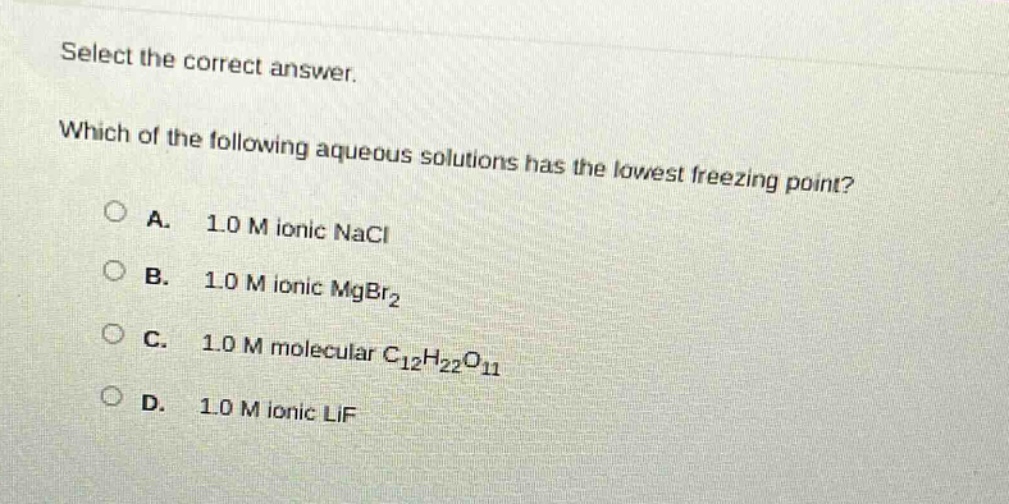
select the correct answer. which of the following aqueous solutions has the lowest freezing point? a. 1.0 m ionic nacl b. 1.0 m ionic mgbr₂ c. 1.0 m molecular c₁₂h₂₂o₁₁ d. 1.0 m ionic lif
Answer
Explanation:
Step1: Recall the freezing - point depression formula
The freezing - point depression formula is $\Delta T_f = iK_fm$, where $\Delta T_f$ is the change in freezing point, $i$ is the van't Hoff factor, $K_f$ is the cryoscopic constant (same for all aqueous solutions here), and $m$ is the molality (assume it's the same as molarity for dilute solutions and in this case, all are 1.0 M). The solution with the highest $i$ value will have the greatest $\Delta T_f$ and thus the lowest freezing point.
Step2: Determine the van't Hoff factor for each compound
- For A. $NaCl$, it dissociates into $Na^+$ and $Cl^-$, so $i = 2$.
- For B. $MgBr_2$, it dissociates into $Mg^{2 + }$ and $2Br^-$, so $i=3$.
- For C. $C_{12}H_{22}O_{11}$, it is a non - electrolyte and does not dissociate in water, so $i = 1$.
- For D. $LiF$, it dissociates into $Li^+$ and $F^-$, so $i = 2$.
Answer:
B. 1.0 M ionic $MgBr_2$