select the correct answer.\na scientist compares two samples of white powder. one powder was present at the…
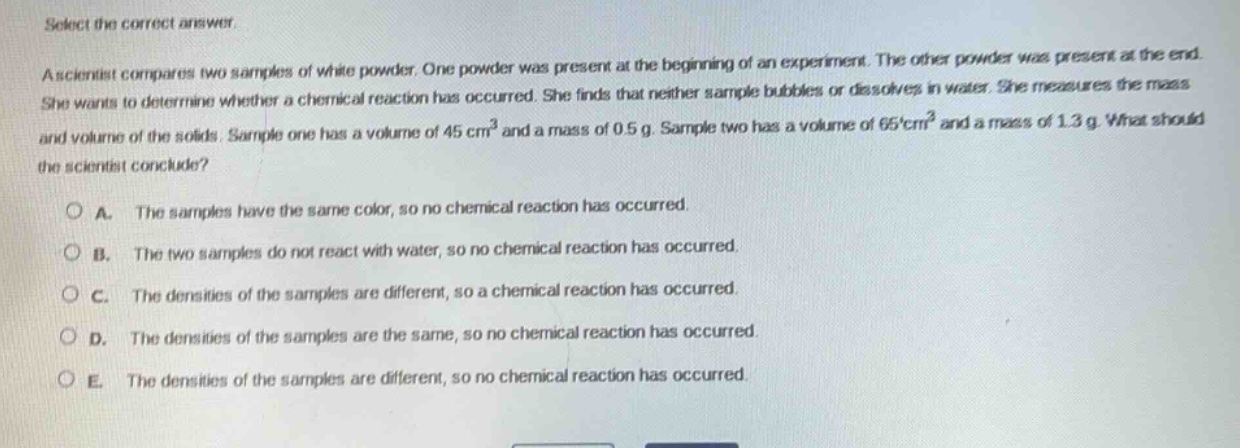
select the correct answer.\na scientist compares two samples of white powder. one powder was present at the beginning of an experiment. the other powder was present at the end. she wants to determine whether a chemical reaction has occurred. she finds that neither sample bubbles or dissolves in water. she measures the mass and volume of the solids. sample one has a volume of 45 cm³ and a mass of 0.5 g. sample two has a volume of 65 cm³ and a mass of 1.3 g. what should the scientist conclude?\n\na. the samples have the same color, so no chemical reaction has occurred.\nb. the two samples do not react with water, so no chemical reaction has occurred.\nc. the densities of the samples are different, so a chemical reaction has occurred.\nd. the densities of the samples are the same, so no chemical reaction has occurred.\ne. the densities of the samples are different, so no chemical reaction has occurred.
Answer
Answer:
C. The densities of the samples are different, so a chemical reaction has occurred.
Explanation:
Step1: Calculate density of sample one
Density formula is $\rho=\frac{m}{V}$. For sample one, $m = 0.5g$ and $V=45cm^{3}$, so $\rho_1=\frac{0.5}{45}\approx0.011g/cm^{3}$.
Step2: Calculate density of sample two
For sample two, $m = 1.3g$ and $V = 65cm^{3}$, so $\rho_2=\frac{1.3}{65}=0.02g/cm^{3}$.
Step3: Analyze result
Since $\rho_1\neq\rho_2$, and a change in density can indicate a chemical - reaction has taken place as new substances may have different physical properties.