select the correct answer.\na solution containing 2.8 moles of magnesium bromide is combined with a solution…
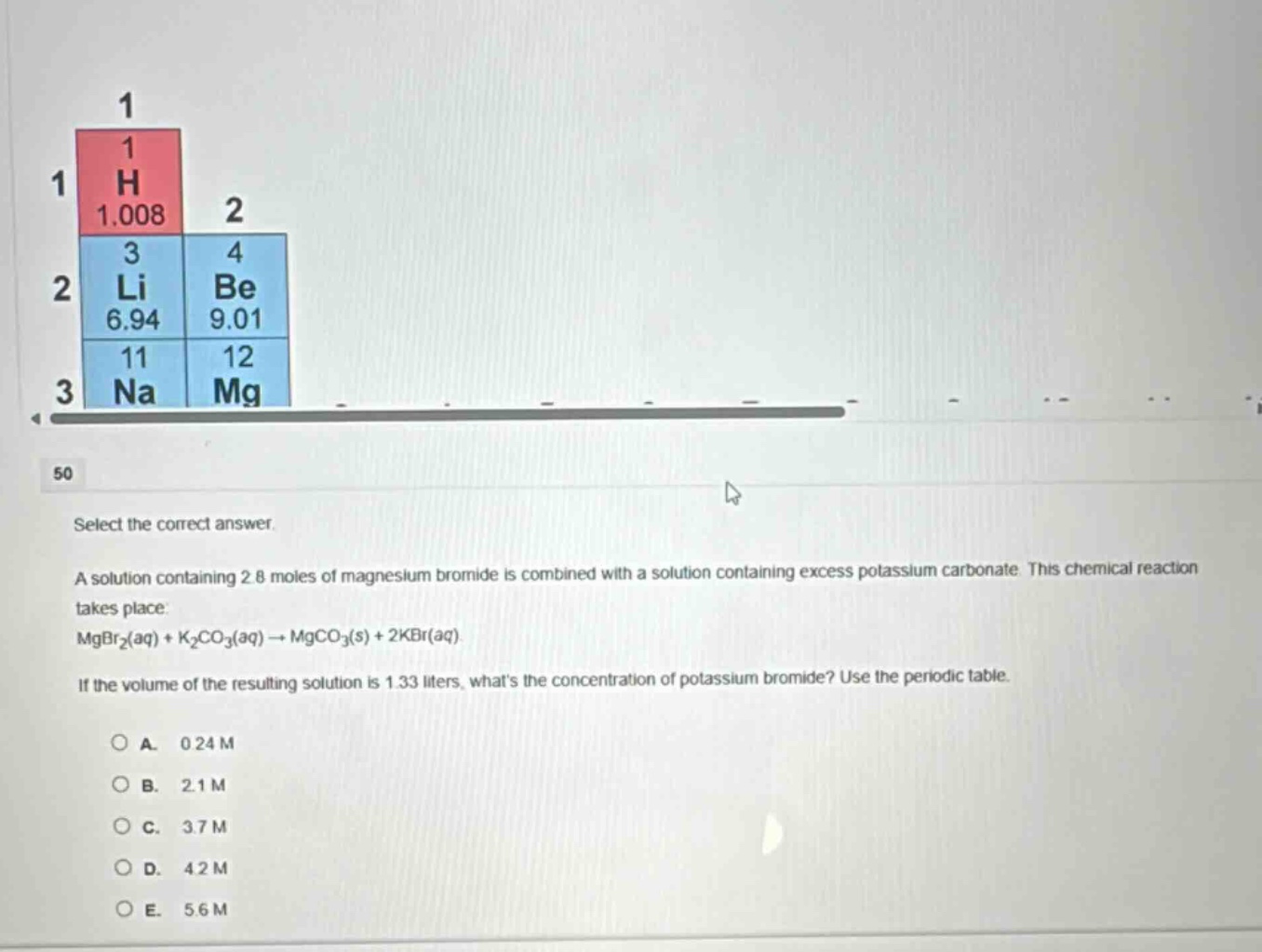
select the correct answer.\na solution containing 2.8 moles of magnesium bromide is combined with a solution containing excess potassium carbonate. this chemical reaction takes place:\nmgbr₂(aq) + k₂co₃(aq) → mgco₃(s) + 2kbr(aq).\nif the volume of the resulting solution is 1.33 liters, whats the concentration of potassium bromide? use the periodic table.\n\no a. 0.24 m\no b. 2.1 m\no c. 3.7 m\no d. 4.2 m\no e. 5.6 m
Answer
Explanation:
Step1: Determine moles of KBr
From the balanced chemical equation $MgBr_2(aq)+K_2CO_3(aq)\rightarrow MgCO_3(s) + 2KBr(aq)$, the mole - ratio of $MgBr_2$ to $KBr$ is 1:2. Given 2.8 moles of $MgBr_2$, the moles of $KBr$ produced is $n = 2\times2.8$ moles. $n = 5.6$ moles
Step2: Calculate the concentration of KBr
The formula for molarity (concentration) is $M=\frac{n}{V}$, where $n$ is the number of moles and $V$ is the volume in liters. Given $n = 5.6$ moles and $V=1.33$ L. $M=\frac{5.6}{1.33}\approx 4.2$ M
Answer:
D. 4.2 M