select the correct mass for each of the samples described below.\n3.01×10²³ molecules h₂o\n8.32×10²⁰ formula…
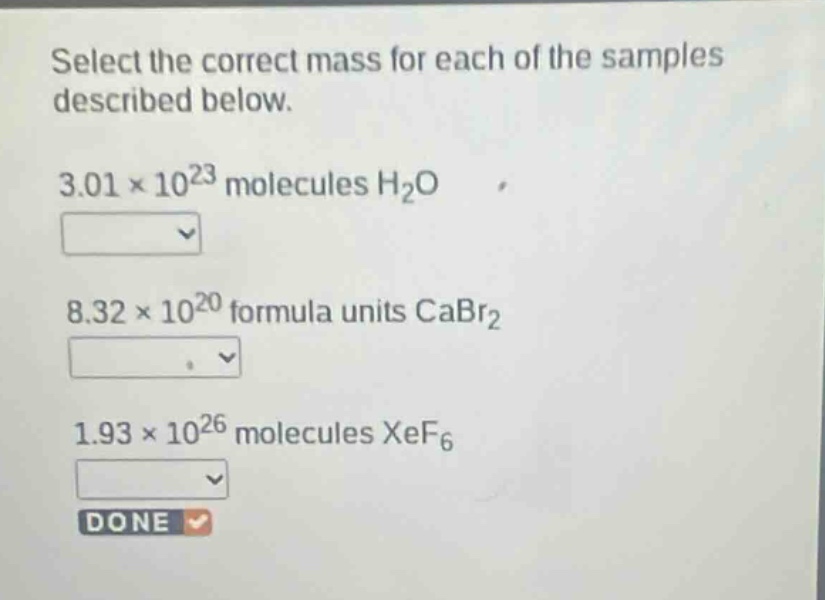
select the correct mass for each of the samples described below.\n3.01×10²³ molecules h₂o\n8.32×10²⁰ formula units cabr₂\n1.93×10²⁶ molecules xef₆\ndone
Answer
Explanation:
Step1: Recall Avogadro's number
Avogadro's number ($N_A$) is $6.022\times 10^{23}$ particles (molecules or formula - units) per mole.
Step2: Calculate moles of $H_2O$
The number of moles ($n$) of $H_2O$ is $n_{H_2O}=\frac{3.01\times 10^{23}}{6.022\times 10^{23}\text{ molecules/mol}} = 0.5\text{ mol}$. The molar mass of $H_2O$ is $M_{H_2O}=(2\times1 + 16)\text{ g/mol}=18\text{ g/mol}$. The mass of $H_2O$ is $m_{H_2O}=n_{H_2O}\times M_{H_2O}=0.5\text{ mol}\times18\text{ g/mol} = 9\text{ g}$.
Step3: Calculate moles of $CaBr_2$
The number of moles of $CaBr_2$ is $n_{CaBr_2}=\frac{8.32\times 10^{20}}{6.022\times 10^{23}\text{ formula - units/mol}}\approx0.00138\text{ mol}$. The molar mass of $CaBr_2$ is $M_{CaBr_2}=40+(2\times79.9)\text{ g/mol}=40 + 159.8\text{ g/mol}=199.8\text{ g/mol}$. The mass of $CaBr_2$ is $m_{CaBr_2}=n_{CaBr_2}\times M_{CaBr_2}=0.00138\text{ mol}\times199.8\text{ g/mol}\approx0.276\text{ g}$.
Step4: Calculate moles of $XeF_6$
The number of moles of $XeF_6$ is $n_{XeF_6}=\frac{1.93\times 10^{26}}{6.022\times 10^{23}\text{ molecules/mol}}\approx320.5\text{ mol}$. The molar mass of $XeF_6$ is $M_{XeF_6}=131.3+(6\times19)\text{ g/mol}=131.3 + 114\text{ g/mol}=245.3\text{ g/mol}$. The mass of $XeF_6$ is $m_{XeF_6}=n_{XeF_6}\times M_{XeF_6}=320.5\text{ mol}\times245.3\text{ g/mol}\approx78628\text{ g}=78.628\text{ kg}$.
Answer:
$9\text{ g}$ for $3.01\times 10^{23}$ molecules $H_2O$; $0.276\text{ g}$ for $8.32\times 10^{20}$ formula - units $CaBr_2$; $78628\text{ g}$ (or $78.628\text{ kg}$) for $1.93\times 10^{26}$ molecules $XeF_6$