t/f: for this skeleton equation, you get 1 mole of oxygen produced for every 1 mole of hgo: hgo -> hg +…
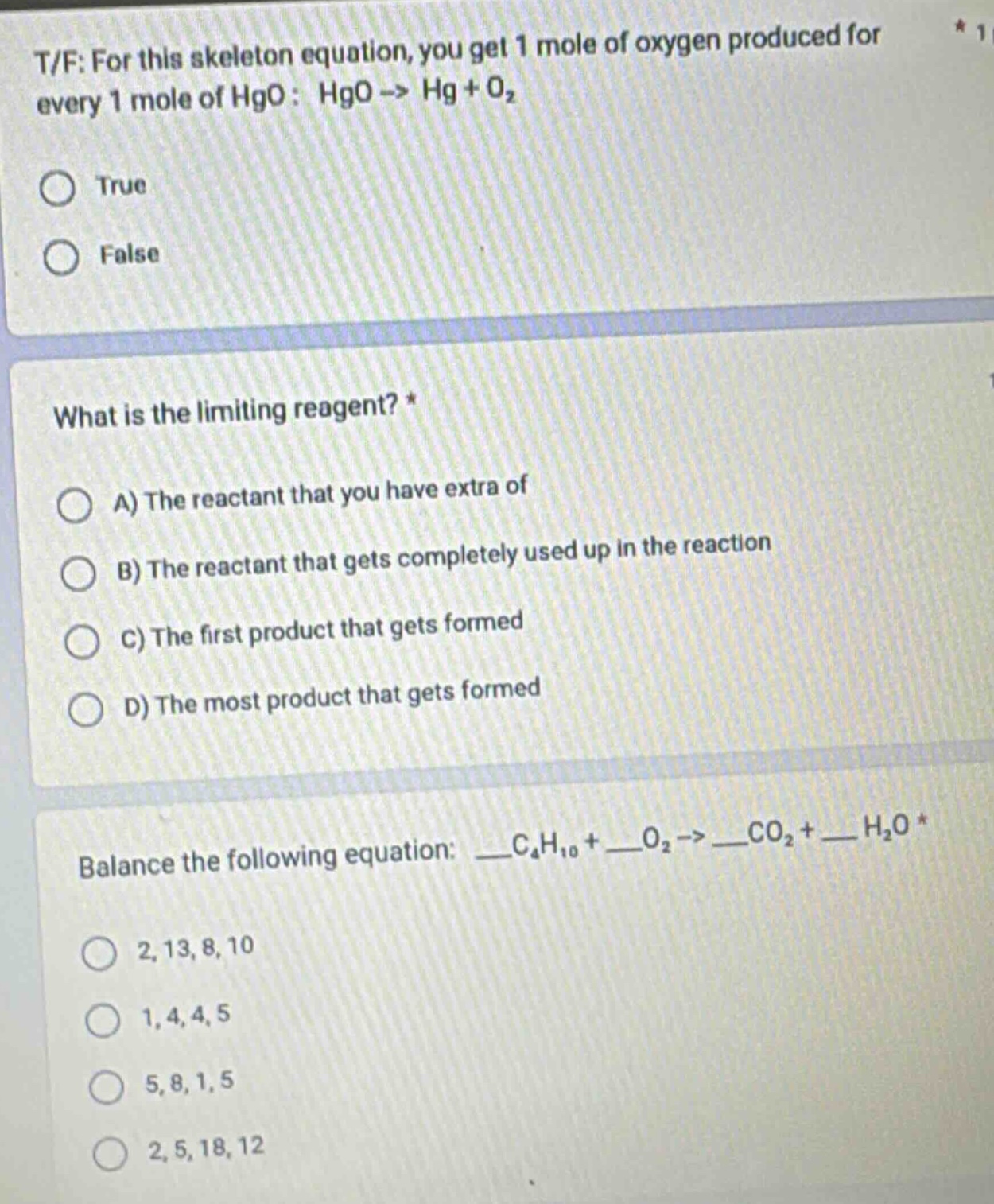
t/f: for this skeleton equation, you get 1 mole of oxygen produced for every 1 mole of hgo: hgo -> hg + o₂\ntrue\nfalse\nwhat is the limiting reagent? *\na) the reactant that you have extra of\nb) the reactant that gets completely used up in the reaction\nc) the first product that gets formed\nd) the most product that gets formed\nbalance the following equation: __c₄h₁₀ + __o₂ -> __co₂ + __h₂o *\n2, 13, 8, 10\n1, 4, 4, 5\n5, 8, 1, 5\n2, 5, 18, 12
Answer
Explanation:
Step1: Balance the first equation
The balanced equation for $HgO\rightarrow Hg + O_2$ is $2HgO\rightarrow 2Hg+O_2$. From this, for every 2 moles of $HgO$, 1 mole of $O_2$ is produced, not 1 mole of $HgO$ for 1 mole of $O_2$. So the answer to the first - true/false question is false.
Step2: Define limiting reagent
The limiting reagent is the reactant that gets completely used up in the reaction. This is the definition of a limiting reagent. So the answer to the second - multiple - choice question is B.
Step3: Balance the third equation
For the equation $C_4H_{10}+O_2\rightarrow CO_2 + H_2O$, first balance the carbon atoms: $C_4H_{10}+O_2\rightarrow 4CO_2+H_2O$. Then balance the hydrogen atoms: $C_4H_{10}+O_2\rightarrow 4CO_2 + 5H_2O$. Finally, balance the oxygen atoms: $2C_4H_{10}+13O_2\rightarrow 8CO_2+10H_2O$. So the coefficients are 2, 13, 8, 10.
Answer:
False B. The reactant that gets completely used up in the reaction 2, 13, 8, 10