this sketch of a neutral molecule is shaded red or blue wherever the electrostatic potential at the…
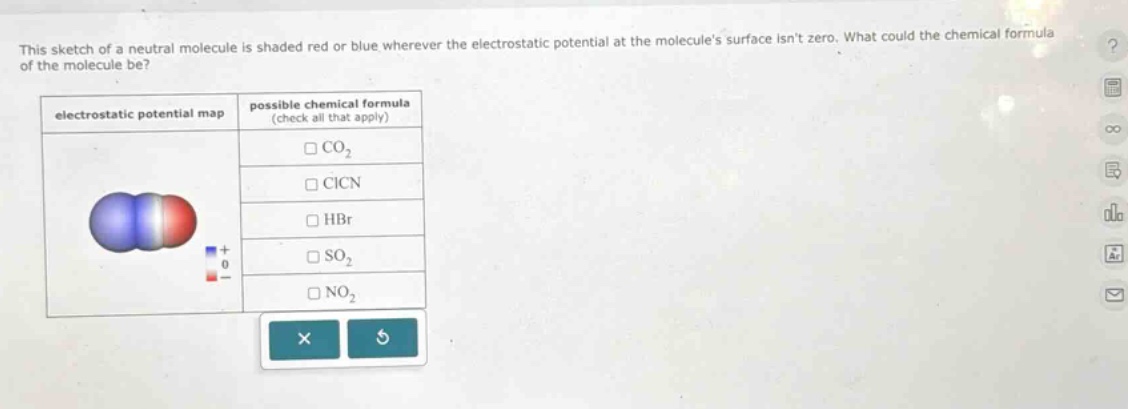
this sketch of a neutral molecule is shaded red or blue wherever the electrostatic potential at the molecules surface isnt zero. what could the chemical formula of the molecule be? electrostatic potential map possible chemical formula (check all that apply) co₂ cicn hbr so₂ no₂
Answer
Explanation:
Step1: Analyze (CO_2)
(CO_2) has a linear structure (O = C=O). The molecule is symmetric, and the dipole moments cancel each other out. So, it has no net dipole moment.
Step2: Analyze (ClCN)
(ClCN) has a structure (Cl - C\equiv N). The electronegativity of (Cl) (3.16), (C) (2.55) and (N) (3.04) are different. The molecule is linear but not symmetric in terms of electron - density distribution. It has a net dipole moment.
Step3: Analyze (HBr)
(HBr) is a diatomic molecule. (Br) (electronegativity 2.96) is more electronegative than (H) (electronegativity 2.20). So, it has a net dipole moment.
Step4: Analyze (SO_2)
(SO_2) has a bent structure. The (S) atom is (sp^2) hybridized. The two (S - O) bonds are polar, and due to the bent geometry, the dipole moments do not cancel. It has a net dipole moment.
Step5: Analyze (NO_2)
(NO_2) has a bent structure. The (N) atom is (sp^2) hybridized. The (N - O) bonds are polar, and due to the bent geometry, the dipole moments do not cancel. It has a net dipole moment.
Answer:
B. (ClCN), C. (HBr), D. (SO_2), E. (NO_2)