3. how does the slope of the line for the strongest acid compare to that of the line for the weakest acid…
3. how does the slope of the line for the strongest acid compare to that of the line for the weakest acid? what does this tell you about the relationship between ph and concentration? type your answer here.
Answer
Brief Explanations:
The strength of an acid is determined by its degree of dissociation in water. Strong acids, like hydrochloric acid (HCl), dissociate completely, while weak acids, like acetic acid ($CH_3COOH$), only partially dissociate. The graph plots pH versus the logarithm of the acid concentration.
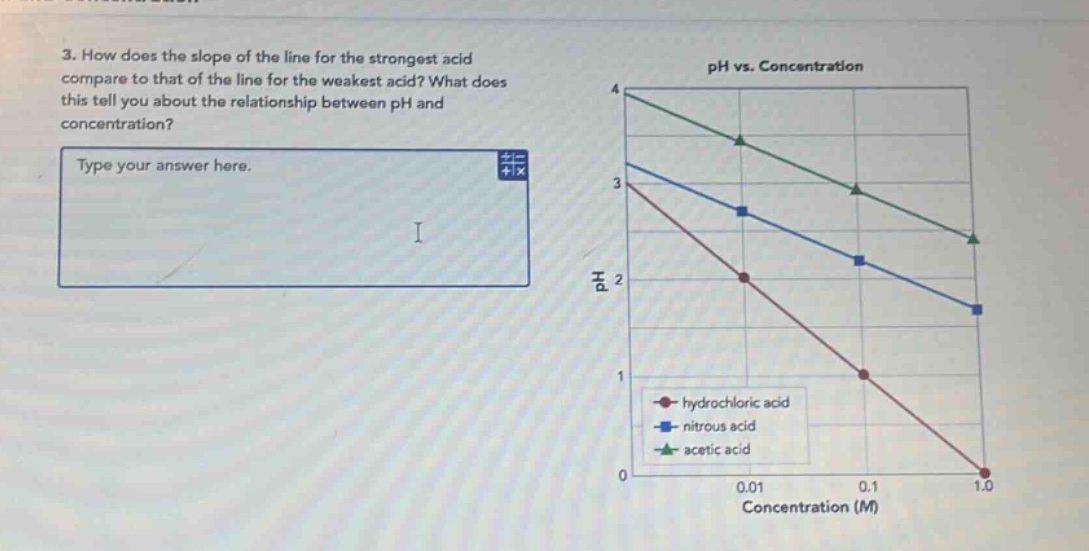
- Identify Strongest and Weakest Acids: From the graph, at any given concentration, hydrochloric acid has the lowest pH, indicating it is the strongest acid. Acetic acid has the highest pH, indicating it is the weakest acid among the three shown.
- Compare Slopes: Observe the lines representing hydrochloric acid and acetic acid. The line for hydrochloric acid is visibly steeper than the line for acetic acid. The slope represents the change in pH per unit change in the logarithm of concentration ($\frac{\Delta pH}{\Delta \log[Concentration]}$).
- Calculate Slopes (Optional but illustrative):
- For Hydrochloric Acid (Strongest): Using points (0.01 M, pH=2) and (1.0 M, pH=0). The change in log(Concentration) is $\log(1.0) - \log(0.01) = 0 - (-2) = 2$. The change in pH is $0 - 2 = -2$. The slope is $\frac{-2}{2} = -1$.
- For Acetic Acid (Weakest): Using approximate points (0.01 M, pH≈3.4) and (1.0 M, pH≈2.4). The change in log(Concentration) is $\log(1.0) - \log(0.01) = 2$. The change in pH is $2.4 - 3.4 = -1$. The slope is $\frac{-1}{2} = -0.5$.
- Interpret the Relationship: The slope for the strongest acid (-1) is steeper (more negative or larger in absolute value) than the slope for the weakest acid (-0.5). This indicates that the pH of a strong acid changes more significantly with changes in concentration compared to a weak acid. Specifically, for every tenfold increase in concentration, the pH of a strong acid decreases by 1 unit, while the pH of this weak acid decreases by approximately 0.5 units. This reflects the direct logarithmic relationship between pH and concentration for strong acids ($pH = -\log[H^+] \approx -\log[C]$) versus the more buffered relationship in weak acids due to equilibrium ($pH = \frac{1}{2}(pK_a - \log[C])$ for sufficiently concentrated weak acids).
Answer:
The slope of the line for the strongest acid (hydrochloric acid) is steeper (more negative) than the slope of the line for the weakest acid (acetic acid). This indicates that the pH of a strong acid is more sensitive to changes in concentration than the pH of a weak acid; a change in concentration causes a larger change in pH for the strong acid compared to the weak acid.