which species completes the nuclear equation shown below?\n$_{84}^{218}po\\rightarrow\\_\\_\\_\\_+_{2}^{4}he$…
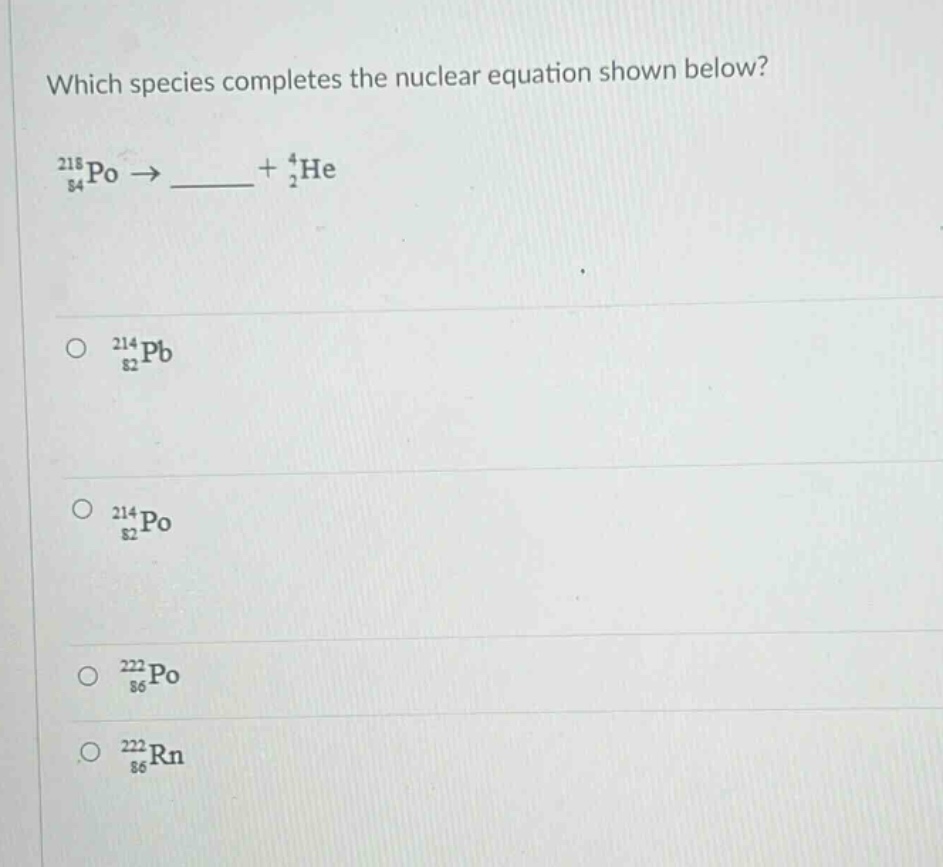
which species completes the nuclear equation shown below?\n$_{84}^{218}po\\rightarrow\\_\\_\\_\\_+_{2}^{4}he$\n$_{82}^{214}pb$\n$_{82}^{214}po$\n$_{86}^{222}po$\n$_{86}^{222}rn$
Answer
Explanation:
Step1: Apply mass - number conservation
In a nuclear equation, the sum of mass - numbers on the left side equals the sum on the right side. The mass - number of $^{218}{84}Po$ is 218 and the mass - number of $^{4}{2}He$ is 4. Let the mass - number of the unknown species be $x$. Then $218=x + 4$, so $x=218 - 4=214$.
Step2: Apply atomic - number conservation
The sum of atomic numbers on the left side equals the sum on the right side. The atomic number of $^{218}{84}Po$ is 84 and the atomic number of $^{4}{2}He$ is 2. Let the atomic number of the unknown species be $y$. Then $84=y + 2$, so $y=84 - 2 = 82$.
Step3: Identify the element
The element with atomic number 82 is lead, symbol $Pb$.
Answer:
$^{214}_{82}Pb$