if the standard heat of formation of a compound is -78.9 kj, this means that\nselect one:\n a. if two moles…
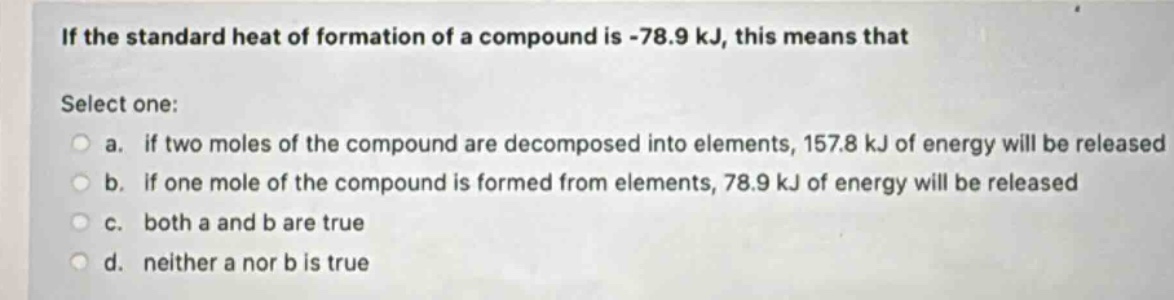
if the standard heat of formation of a compound is -78.9 kj, this means that\nselect one:\n a. if two moles of the compound are decomposed into elements, 157.8 kj of energy will be released\n b. if one mole of the compound is formed from elements, 78.9 kj of energy will be released\n c. both a and b are true\n d. neither a nor b is true
Answer
Brief Explanations:
The standard heat of formation ($\Delta H_f^\circ$) is the enthalpy change when one mole of a compound is formed from its constituent elements in their standard states. A negative $\Delta H_f^\circ$ (-78.9 kJ) indicates an exothermic reaction (energy is released).
- For option a: If the formation of 1 mole releases 78.9 kJ (from $\Delta H_f^\circ=- 78.9$ kJ/mol), then decomposition of 2 moles (reverse reaction) would absorb (2\times78.9 = 157.8) kJ (not release). So option a is false.
- For option b: Since $\Delta H_f^\circ=-78.9$ kJ/mol, when 1 mole of the compound is formed from elements (exothermic), 78.9 kJ of energy is released. So option b is true.
Answer:
B. If one mole of the compound is formed from elements, 78.9 kJ of energy will be released