what statement best explains why fluorine has a smaller atomic radius than oxygen?\na. fluorine has fewer…
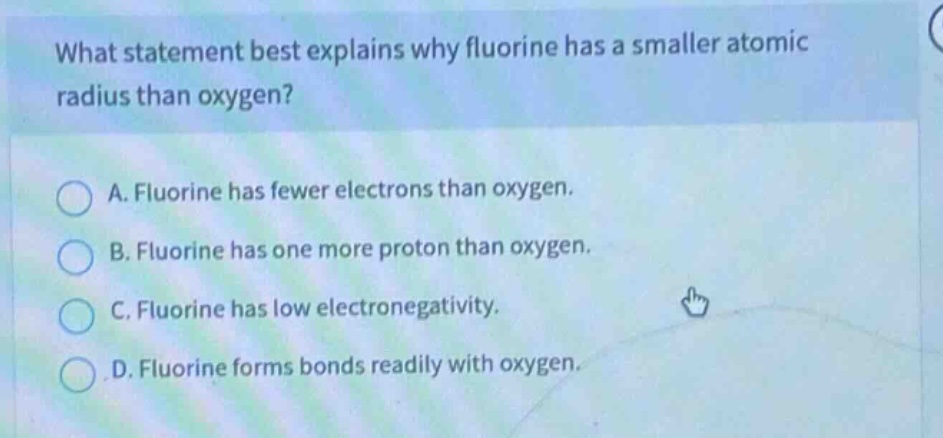
what statement best explains why fluorine has a smaller atomic radius than oxygen?\na. fluorine has fewer electrons than oxygen.\nb. fluorine has one more proton than oxygen.\nc. fluorine has low electronegativity.\nd. fluorine forms bonds readily with oxygen.
Answer
Brief Explanations:
Atomic radius decreases across a period due to an increase in the effective nuclear charge. Fluorine (F) has an atomic number of 9 and oxygen (O) has an atomic number of 8. This means fluorine has one more proton in its nucleus than oxygen. The extra proton in fluorine attracts the electrons more strongly, pulling them closer to the nucleus and resulting in a smaller atomic radius. Option A is incorrect as fluorine has more electrons than oxygen. Option C is wrong because fluorine has the highest electronegativity among all elements. Option D is not relevant to the explanation of atomic - radius difference.
Answer:
B. Fluorine has one more proton than oxygen.