which statement describes the arrhenius interpretation of acids and bases?\no it has a wider range of…
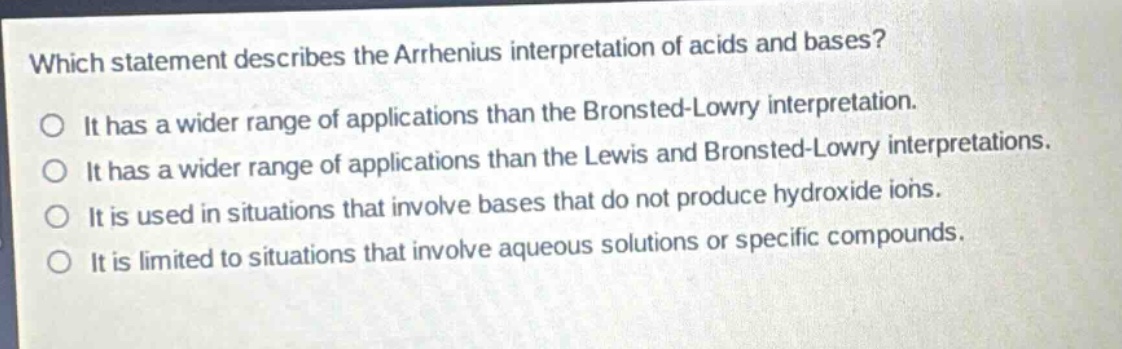
which statement describes the arrhenius interpretation of acids and bases?\no it has a wider range of applications than the bronsted - lowry interpretation.\no it has a wider range of applications than the lewis and bronsted - lowry interpretations.\no it is used in situations that involve bases that do not produce hydroxide ions.\no it is limited to situations that involve aqueous solutions or specific compounds.
Answer
Brief Explanations:
The Arrhenius theory defines acids as substances that produce hydrogen ions ($H^+$) in aqueous solution and bases as substances that produce hydroxide ions ($OH^-$) in aqueous solution. It is limited to aqueous - solution environments and specific compounds. The Brønsted - Lowry and Lewis theories have broader scopes as they can account for acid - base behavior in non - aqueous systems and for substances that don't fit the Arrhenius definitions.
Answer:
It is limited to situations that involve aqueous solutions or specific compounds.