these statements describe three different reactions. 1 - an atom shares electrons with another atom. 2 - the…
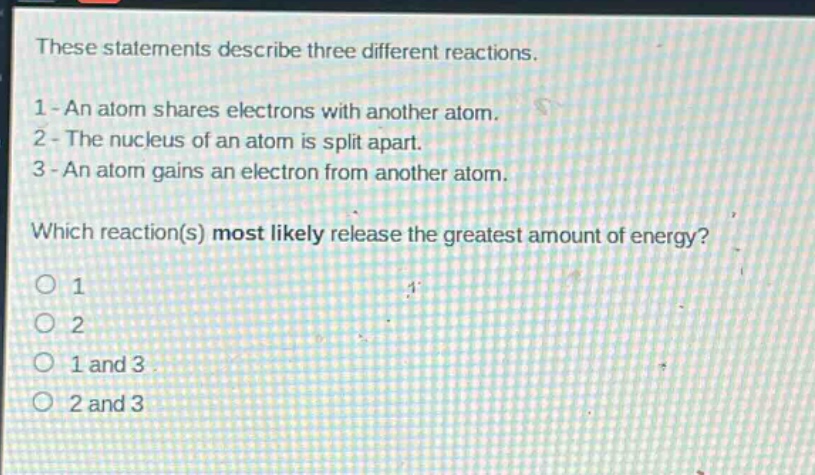
these statements describe three different reactions. 1 - an atom shares electrons with another atom. 2 - the nucleus of an atom is split apart. 3 - an atom gains an electron from another atom. which reaction(s) most likely release the greatest amount of energy? 1 2 1 and 3 2 and 3
Answer
Explanation:
Step1: Identify the reaction types
1 is a covalent - bonding reaction (sharing electrons), 3 is an ionic - bonding reaction (transfer of electrons). These involve electron - level changes. 2 is a nuclear fission reaction where the nucleus of an atom is split.
Step2: Compare energy releases
Nuclear reactions (like splitting the nucleus) release much more energy than chemical reactions (electron - sharing or electron - transfer). Chemical reactions involve changes in electron arrangements, while nuclear reactions involve changes in the nucleus. The energy stored in the nucleus is much greater than the energy involved in electron - level interactions.
Answer:
2