which of these statements are true? select all that apply. the $delta h_f$ for $br_2(l)$ is 0 kj/mol. the…
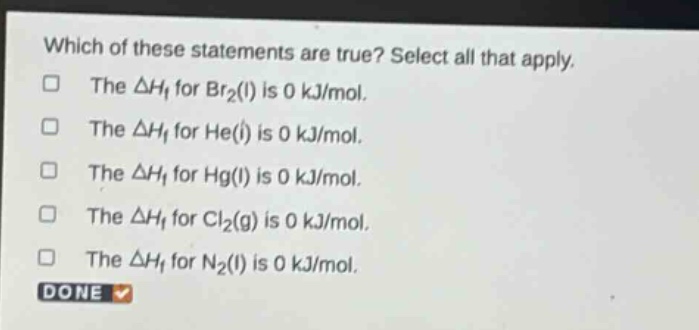
which of these statements are true? select all that apply. the $delta h_f$ for $br_2(l)$ is 0 kj/mol. the $delta h_f$ for $he(l)$ is 0 kj/mol. the $delta h_f$ for $hg(l)$ is 0 kj/mol. the $delta h_f$ for $cl_2(g)$ is 0 kj/mol. the $delta h_f$ for $n_2(l)$ is 0 kj/mol. done
Answer
Brief Explanations:
La entalpía de formación estándar ($\Delta H_f$) de un elemento en su estado natural y estándar es cero. Bromo ($Br_2$) en estado líquido, helio ($He$) en estado gaseoso, mercurio ($Hg$) en estado líquido y cloro ($Cl_2$) en estado gaseoso son los estados naturales y estándares de estos elementos respectivamente. Nitrógeno ($N_2$) en estado natural y estándar es gaseoso, no líquido.
Answer:
- The $\Delta H_f$ for $Br_2$(l) is 0 kJ/mol.
- The $\Delta H_f$ for $He$(g) is 0 kJ/mol.
- The $\Delta H_f$ for $Hg$(l) is 0 kJ/mol.
- The $\Delta H_f$ for $Cl_2$(g) is 0 kJ/mol.
- The $\Delta H_f$ for $N_2$(l) is not 0 kJ/mol. Entonces solo se selecciona la primera, tercera y cuarta opciones.