in step 5, you will calculate h+/oh- ratios for more extreme ph solutions. find the concentration of h+ ions…
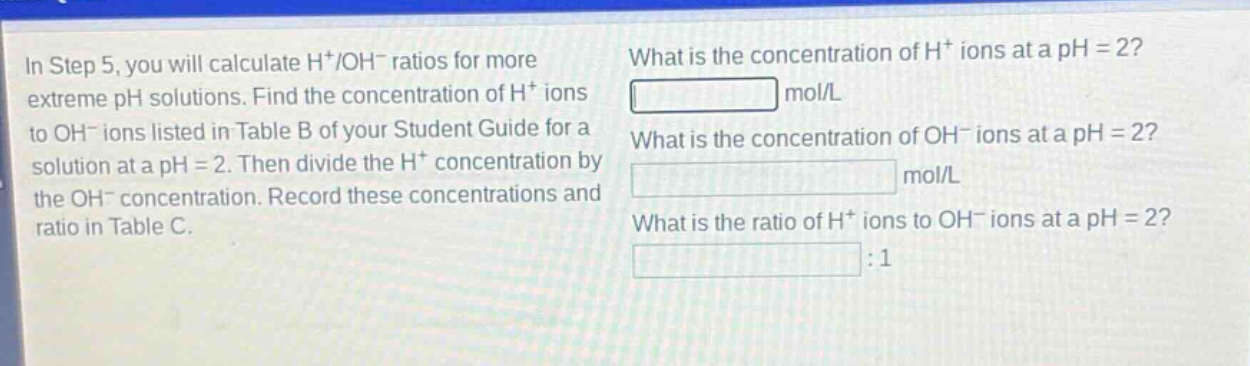
in step 5, you will calculate h+/oh- ratios for more extreme ph solutions. find the concentration of h+ ions to oh- ions listed in table b of your student guide for a solution at a ph = 2. then divide the h+ concentration by the oh- concentration. record these concentrations and ratio in table c. what is the concentration of h+ ions at a ph = 2? mol/l what is the concentration of oh- ions at a ph = 2? mol/l what is the ratio of h+ ions to oh- ions at a ph = 2? :1
Answer
Explanation:
Step1: Recall pH formula
The formula for pH is $pH = -\log[H^{+}]$. Given $pH = 2$, we can solve for $[H^{+}]$. Rearranging the formula gives $[H^{+}]=10^{-pH}$. $[H^{+}]=10^{- 2}\text{ mol/L}=0.01\text{ mol/L}$
Step2: Recall the relationship between $[H^{+}]$ and $[OH^{-}]$
The ion - product constant of water $K_w=[H^{+}][OH^{-}]=1.0\times10^{-14}$ at $25^{\circ}C$. We know $[H^{+}]=10^{-2}\text{ mol/L}$, so we can solve for $[OH^{-}]$ by rearranging the formula: $[OH^{-}]=\frac{K_w}{[H^{+}]}$. $[OH^{-}]=\frac{1.0\times10^{-14}}{10^{-2}} = 10^{-12}\text{ mol/L}$
Step3: Calculate the ratio of $[H^{+}]$ to $[OH^{-}]$
The ratio of $[H^{+}]$ to $[OH^{-}]$ is $\frac{[H^{+}]}{[OH^{-}]}$. Substituting the values of $[H^{+}]=10^{-2}\text{ mol/L}$ and $[OH^{-}]=10^{-12}\text{ mol/L}$, we get $\frac{10^{-2}}{10^{-12}}=10^{10}$.
Answer:
$0.01$ $10^{-12}$ $10^{10}$