stoichiometry test\nmake sure to show all work including conversion factors and give correct units with your…
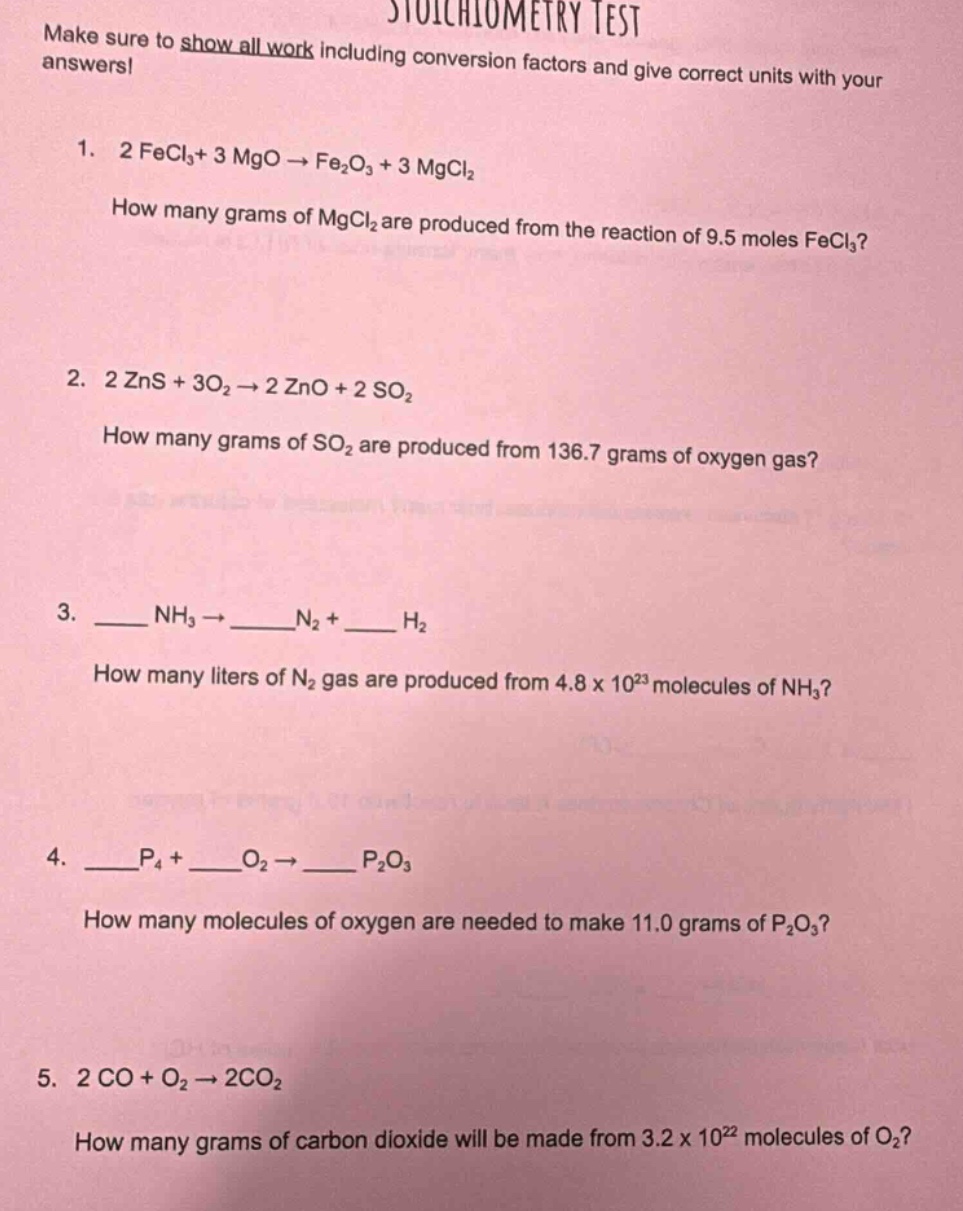
stoichiometry test\nmake sure to show all work including conversion factors and give correct units with your answers!\n1. 2 fecl₃ + 3 mgo → fe₂o₃ + 3 mgcl₂\nhow many grams of mgcl₂ are produced from the reaction of 9.5 moles fecl₃?\n2. 2 zns + 3o₂ → 2 zno + 2 so₂\nhow many grams of so₂ are produced from 136.7 grams of oxygen gas?\n3. ____ nh₃ → ____n₂ + ____ h₂\nhow many liters of n₂ gas are produced from 4.8 x 10²³ molecules of nh₃?\n4. ____p₄ + ____o₂ → ____ p₂o₃\nhow many molecules of oxygen are needed to make 11.0 grams of p₂o₃?\n5. 2 co + o₂ → 2co₂\nhow many grams of carbon dioxide will be made from 3.2 x 10²² molecules of o₂?
Answer
1.
Explanation:
Step1: Determine mole - ratio
From the balanced equation $2FeCl_3 + 3MgO\rightarrow Fe_2O_3+3MgCl_2$, the mole - ratio of $FeCl_3$ to $MgCl_2$ is $2:3$.
Step2: Calculate moles of $MgCl_2$
If we have $n(FeCl_3)=9.5$ moles, then $n(MgCl_2)=\frac{3}{2}\times n(FeCl_3)=\frac{3}{2}\times9.5 = 14.25$ moles.
Step3: Calculate mass of $MgCl_2$
The molar mass of $MgCl_2$ is $M(MgCl_2)=24.31+(2\times35.45)=95.21$ g/mol. So, $m(MgCl_2)=n(MgCl_2)\times M(MgCl_2)=14.25\times95.21 = 1356.74$ g.
Answer:
$1356.74$ g
2.
Explanation:
Step1: Calculate moles of $O_2$
The molar mass of $O_2$ is $M(O_2) = 32$ g/mol. Given $m(O_2)=136.7$ g, then $n(O_2)=\frac{m(O_2)}{M(O_2)}=\frac{136.7}{32}=4.272$ moles.
Step2: Determine mole - ratio
From the balanced equation $2ZnS + 3O_2\rightarrow2ZnO + 2SO_2$, the mole - ratio of $O_2$ to $SO_2$ is $3:2$.
Step3: Calculate moles of $SO_2$
$n(SO_2)=\frac{2}{3}\times n(O_2)=\frac{2}{3}\times4.272 = 2.848$ moles.
Step4: Calculate mass of $SO_2$
The molar mass of $SO_2$ is $M(SO_2)=32+(2\times16)=64$ g/mol. So, $m(SO_2)=n(SO_2)\times M(SO_2)=2.848\times64 = 182.27$ g.
Answer:
$182.27$ g
3.
First, balance the equation: $2NH_3\rightarrow N_2 + 3H_2$
Explanation:
Step1: Calculate moles of $NH_3$
Using Avogadro's number $N_A = 6.022\times10^{23}$ molecules/mol. Given $N(NH_3)=4.8\times 10^{23}$ molecules, then $n(NH_3)=\frac{N(NH_3)}{N_A}=\frac{4.8\times 10^{23}}{6.022\times10^{23}} = 0.797$ moles.
Step2: Determine mole - ratio
The mole - ratio of $NH_3$ to $N_2$ is $2:1$. So, $n(N_2)=\frac{1}{2}\times n(NH_3)=\frac{1}{2}\times0.797 = 0.3985$ moles.
Step3: Calculate volume of $N_2$
At standard temperature and pressure (STP), 1 mole of any gas occupies 22.4 L. So, $V(N_2)=n(N_2)\times22.4=0.3985\times22.4 = 8.93$ L.
Answer:
$8.93$ L
4.
First, balance the equation: $2P_4+6O_2\rightarrow4P_2O_3$
Explanation:
Step1: Calculate moles of $P_2O_3$
The molar mass of $P_2O_3$ is $M(P_2O_3)=(2\times30.97)+(3\times16)=109.94$ g/mol. Given $m(P_2O_3)=11.0$ g, then $n(P_2O_3)=\frac{m(P_2O_3)}{M(P_2O_3)}=\frac{11.0}{109.94}=0.1$ moles.
Step2: Determine mole - ratio
The mole - ratio of $O_2$ to $P_2O_3$ is $6:4 = 3:2$. So, $n(O_2)=\frac{3}{2}\times n(P_2O_3)=\frac{3}{2}\times0.1 = 0.15$ moles.
Step3: Calculate number of molecules of $O_2$
Using Avogadro's number, $N(O_2)=n(O_2)\times N_A=0.15\times6.022\times10^{23}=9.033\times 10^{22}$ molecules.
Answer:
$9.033\times 10^{22}$ molecules
5.
Explanation:
Step1: Calculate moles of $O_2$
Using Avogadro's number $N_A = 6.022\times10^{23}$ molecules/mol. Given $N(O_2)=3.2\times 10^{22}$ molecules, then $n(O_2)=\frac{N(O_2)}{N_A}=\frac{3.2\times 10^{22}}{6.022\times10^{23}}=0.0531$ moles.
Step2: Determine mole - ratio
From the balanced equation $2CO + O_2\rightarrow2CO_2$, the mole - ratio of $O_2$ to $CO_2$ is $1:2$. So, $n(CO_2)=2\times n(O_2)=2\times0.0531 = 0.1062$ moles.
Step3: Calculate mass of $CO_2$
The molar mass of $CO_2$ is $M(CO_2)=12+(2\times16)=44$ g/mol. So, $m(CO_2)=n(CO_2)\times M(CO_2)=0.1062\times44 = 4.67$ g.
Answer:
$4.67$ g