study the following phase diagram of substance x.\nuse this diagram to answer the following…
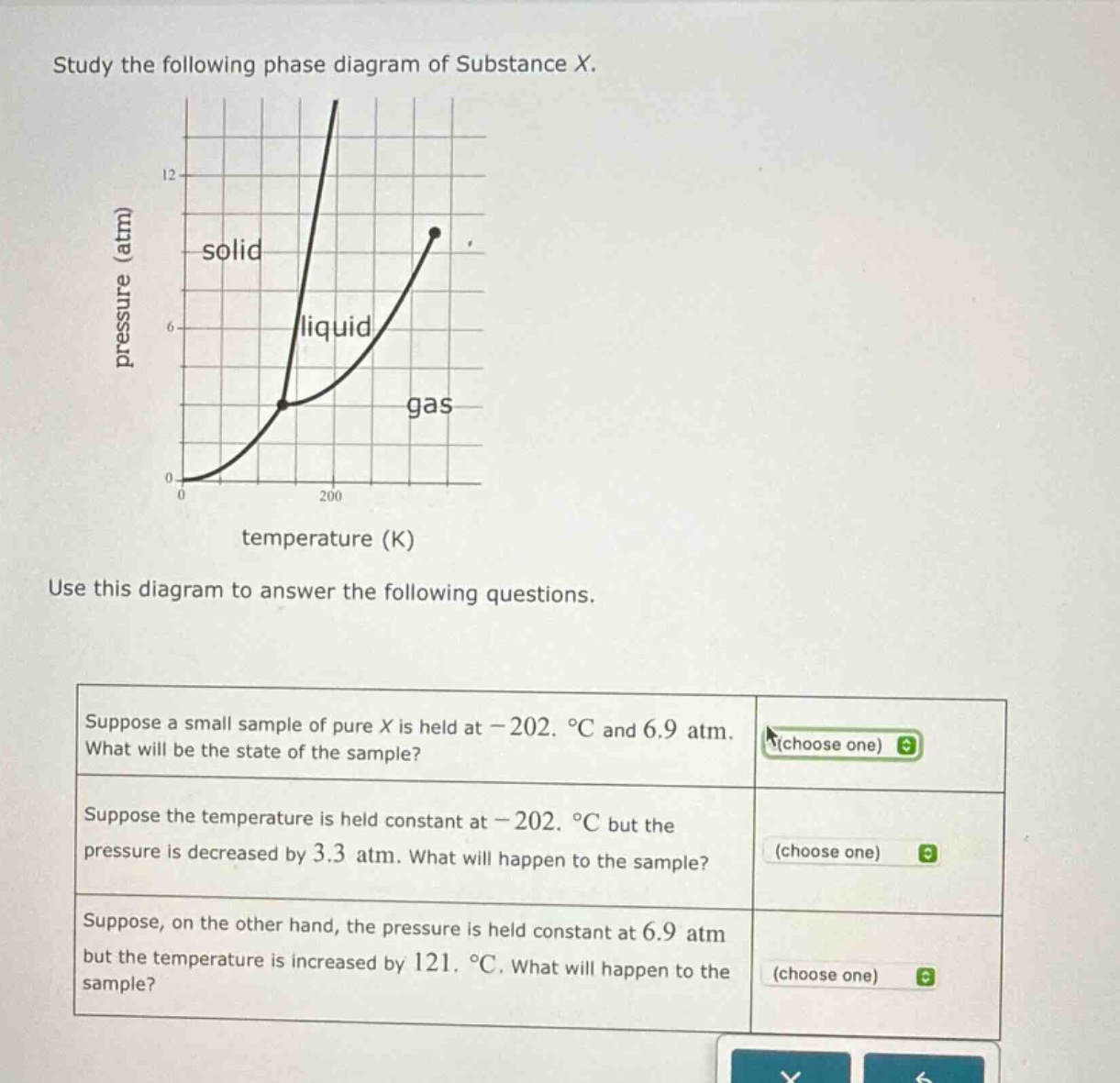
study the following phase diagram of substance x.\nuse this diagram to answer the following questions.\nsuppose a small sample of pure x is held at - 202. °c and 6.9 atm. what will be the state of the sample?\nsuppose the temperature is held constant at - 202. °c but the pressure is decreased by 3.3 atm. what will happen to the sample?\nsuppose, on the other hand, the pressure is held constant at 6.9 atm but the temperature is increased by 121. °c. what will happen to the sample?
Answer
Explanation:
Step1: Convert temperature to Kelvin
First, convert - 202°C to Kelvin. The conversion formula is $T(K)=T(^{\circ}C)+273.15$. So, $T = - 202+273.15=71.15$ K. Locate 71.15 K and 6.9 atm on the phase - diagram. The sample is in the solid state.
Step2: Calculate new pressure
The new pressure is $P = 6.9 - 3.3=3.6$ atm. With temperature held at 71.15 K and new pressure 3.6 atm, moving horizontally (constant - temperature) on the phase - diagram from 6.9 atm to 3.6 atm, the sample will sublime (change directly from solid to gas).
Step3: Calculate new temperature
The new temperature is $T=-202 + 121=-81^{\circ}C$. Convert to Kelvin: $T=-81 + 273.15 = 192.15$ K. With pressure held at 6.9 atm and moving vertically (constant - pressure) on the phase - diagram from 71.15 K to 192.15 K, the sample will melt (change from solid to liquid).
Answer:
- Solid
- Sublime
- Melt