when sugar is burned, water vapor and carbon dioxide are produced. a sugar molecule has a specific number of…
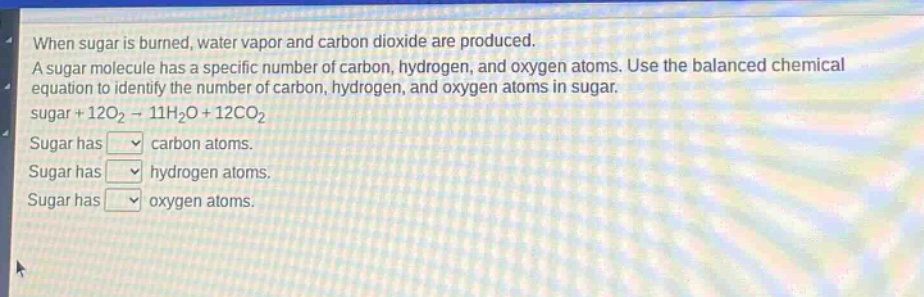
when sugar is burned, water vapor and carbon dioxide are produced. a sugar molecule has a specific number of carbon, hydrogen, and oxygen atoms. use the balanced chemical equation to identify the number of carbon, hydrogen, and oxygen atoms in sugar. sugar + 12o₂ → 11h₂o + 12co₂ sugar has carbon atoms. sugar has hydrogen atoms. sugar has oxygen atoms.
Answer
Explanation:
Step1: Analyze carbon atoms
On the right - hand side of the equation, in $12CO_2$, the number of carbon atoms is 12. Since the left - hand side has sugar and $12O_2$, and oxygen doesn't contribute carbon, sugar must have 12 carbon atoms.
Step2: Analyze hydrogen atoms
On the right - hand side, in $11H_2O$, the number of hydrogen atoms is $11\times2 = 22$. Since oxygen doesn't contribute hydrogen, sugar must have 22 hydrogen atoms.
Step3: Analyze oxygen atoms
On the right - hand side, the total number of oxygen atoms in $11H_2O$ is 11 and in $12CO_2$ is $12\times2=24$, so a total of $11 + 24=35$ oxygen atoms. On the left - hand side, $12O_2$ has $12\times2 = 24$ oxygen atoms. So the number of oxygen atoms in sugar is $35-24 = 11$.
Answer:
Sugar has 12 carbon atoms. Sugar has 22 hydrogen atoms. Sugar has 11 oxygen atoms.