1. sugar is stirred in water until it dissolves.\n2. water boils until its volume is reduced by half.\n3…
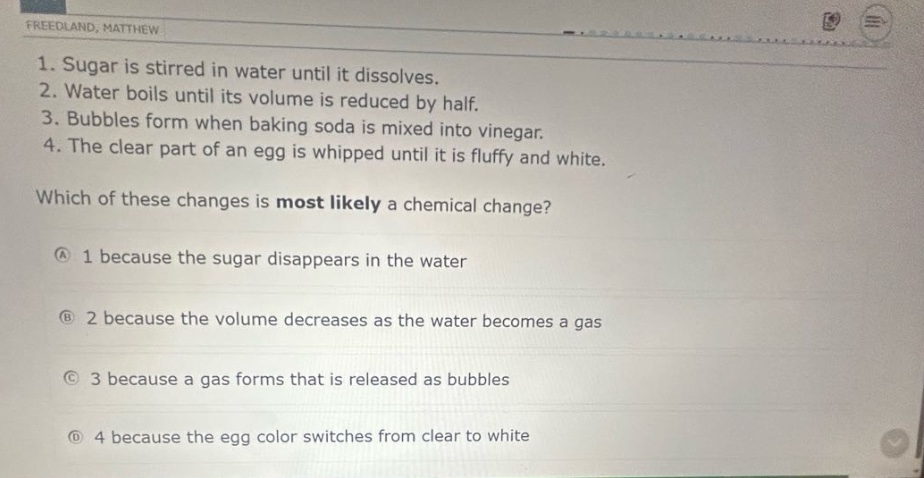
1. sugar is stirred in water until it dissolves.\n2. water boils until its volume is reduced by half.\n3. bubbles form when baking soda is mixed into vinegar.\n4. the clear part of an egg is whipped until it is fluffy and white.\nwhich of these changes is most likely a chemical change?\na 1 because the sugar disappears in the water\nb 2 because the volume decreases as the water becomes a gas\nc 3 because a gas forms that is released as bubbles\nd 4 because the egg color switches from clear to white
Answer
Explanation:
Step1: Define chemical change
A chemical change results in the formation of new substances.
Step2: Analyze option 1
Sugar dissolving in water is a physical change as no new substance is formed, just a mixture (solution).
Step3: Analyze option 2
Water boiling and reducing in volume is a physical change (change of state from liquid to gas), no new substance is formed.
Step4: Analyze option 3
When baking soda (sodium bicarbonate) reacts with vinegar (acetic acid), carbon - dioxide gas is formed. Formation of a new gas indicates a chemical change.
Step5: Analyze option 4
Whipping the egg white changes its physical state (from liquid to a fluffy foam) due to incorporation of air, but no new chemical substances are formed.
Answer:
C. 3 because a gas forms that is released as bubbles