sulfuric acid is a very strong acid that can act as an oxidizing agent at high concentrations (very low ph…
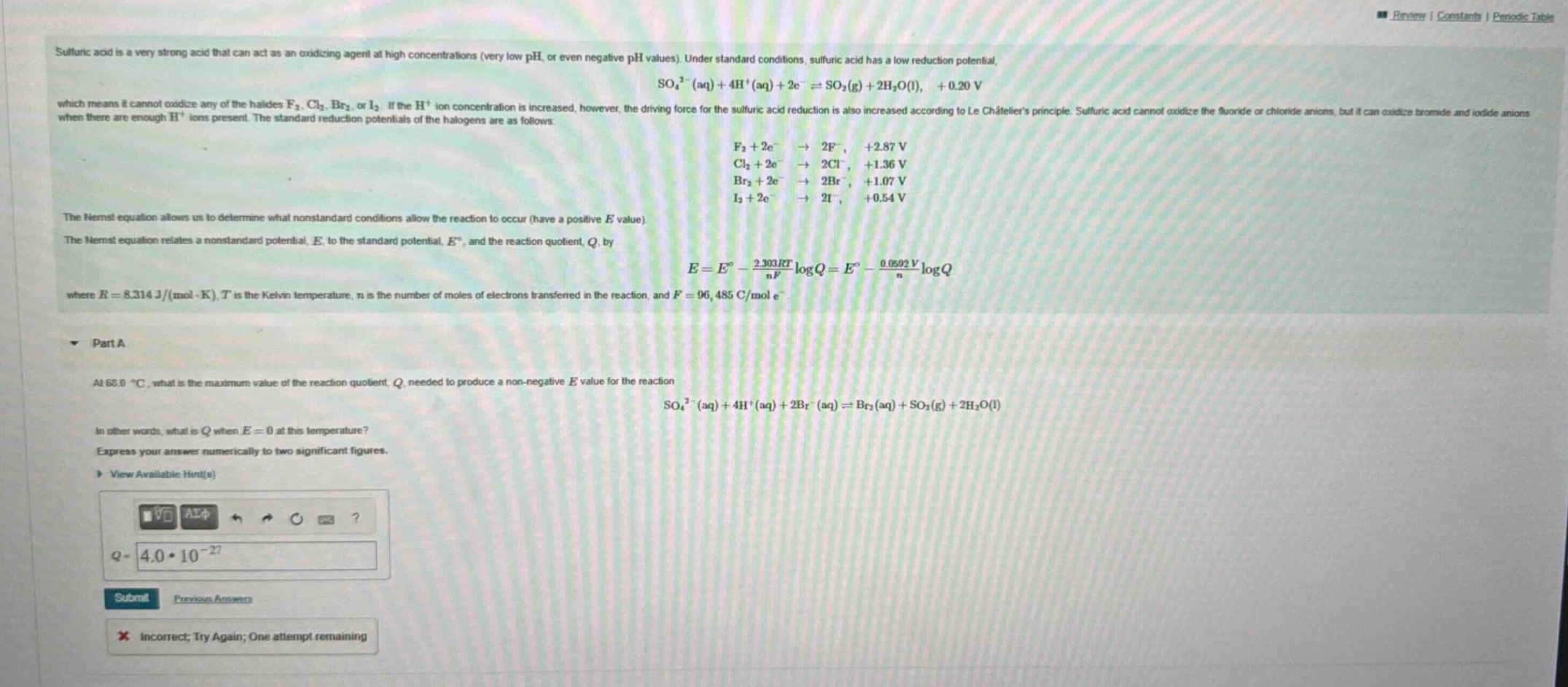
sulfuric acid is a very strong acid that can act as an oxidizing agent at high concentrations (very low ph, or even negative ph values). under standard conditions, sulfuric acid has a low reduction potential, so₄²⁻(aq) + 4h⁺(aq) + 2e⁻ ⇌ so₂(g) + 2h₂o(l), +0.20 v which means it cannot oxidize any of the halides f₂, cl₂, br₂, or i₂. if the h⁺ ion concentration is increased, however, the driving force for the sulfuric acid reduction is also increased according to le châteliers principle. sulfuric acid cannot oxidize the fluoride or chloride anions, but it can oxidize bromide and iodide anions when there are enough h⁺ ions present. the standard reduction potentials of the halogens are as follows: f₂ + 2e⁻ → 2f⁻, +2.87 v cl₂ + 2e⁻ → 2cl⁻, +1.36 v br₂ + 2e⁻ → 2br⁻, +1.07 v i₂ + 2e⁻ → 2i⁻, +0.54 v the nernst equation allows us to determine what nonstandard conditions allow the reaction to occur (have a positive e value). the nernst equation relates a nonstandard potential, e, to the standard potential, e°, and the reaction quotient, q, by e = e° - 2.303rt/nf logq = e° - 0.0592 v/n logq where r = 8.314 j/(mol·k), t is the kelvin temperature, n is the number of moles of electrons transferred in the reaction, and f = 96,485 c/mol e⁻. part a at 68.0 °c, what is the maximum value of the reaction quotient, q, needed to produce a non - negative e value for the reaction so₄²⁻(aq) + 4h⁺(aq) + 2br⁻(aq) ⇌ br₂(aq) + so₂(g) + 2h₂o(l) in other words, what is q when e = 0 at this temperature? express your answer numerically to two significant figures. view available hint(s) q = 4.0·10⁻²⁷ submit previous answers incorrect; try again; one attempt remaining
Answer
Explanation:
Step1: Determine standard - reduction potentials
The standard reduction potential for $\text{SO}_4^{2 - }+4\text{H}^++2\text{e}^-\rightleftharpoons\text{SO}_2 + 2\text{H}2\text{O}$ is $E_1^{\circ}= + 0.20\text{ V}$, and for $\text{Br}2+2\text{e}^-\rightleftharpoons2\text{Br}^-$ is $E_2^{\circ}=+1.07\text{ V}$. The standard cell potential $E^{\circ}=E{cathode}^{\circ}-E{anode}^{\circ}=0.20 - 1.07=- 0.87\text{ V}$.
Step2: Convert temperature to Kelvin
Given $T = 68.0^{\circ}\text{C}$, convert it to Kelvin: $T=(68.0 + 273.15)\text{ K}=341.15\text{ K}$.
Step3: Use the Nernst equation
The Nernst equation is $E = E^{\circ}-\frac{0.0592\text{ V}}{n}\log Q$. When $E = 0$, we can solve for $Q$. Rearranging the Nernst - equation gives $\log Q=\frac{nE^{\circ}}{0.0592\text{ V}}$. In the reaction $\text{SO}_4^{2 - }(\text{aq})+4\text{H}^+(\text{aq})+2\text{Br}^-(\text{aq})\rightleftharpoons\text{Br}_2(\text{aq})+\text{SO}_2(\text{g})+2\text{H}_2\text{O}(\text{l})$, the number of moles of electrons transferred $n = 2$. Substitute $n = 2$ and $E^{\circ}=-0.87\text{ V}$ into the equation: $\log Q=\frac{2\times(- 0.87\text{ V})}{0.0592\text{ V}}=\frac{-1.74\text{ V}}{0.0592\text{ V}}\approx - 29.4$. Then $Q = 10^{-29.4}\approx4.0\times10^{-30}$.
Answer:
$4.0\times10^{-30}$