suppose that a reaction a → products is exothermic (as in the diagram) and has an energy of activation of 75…
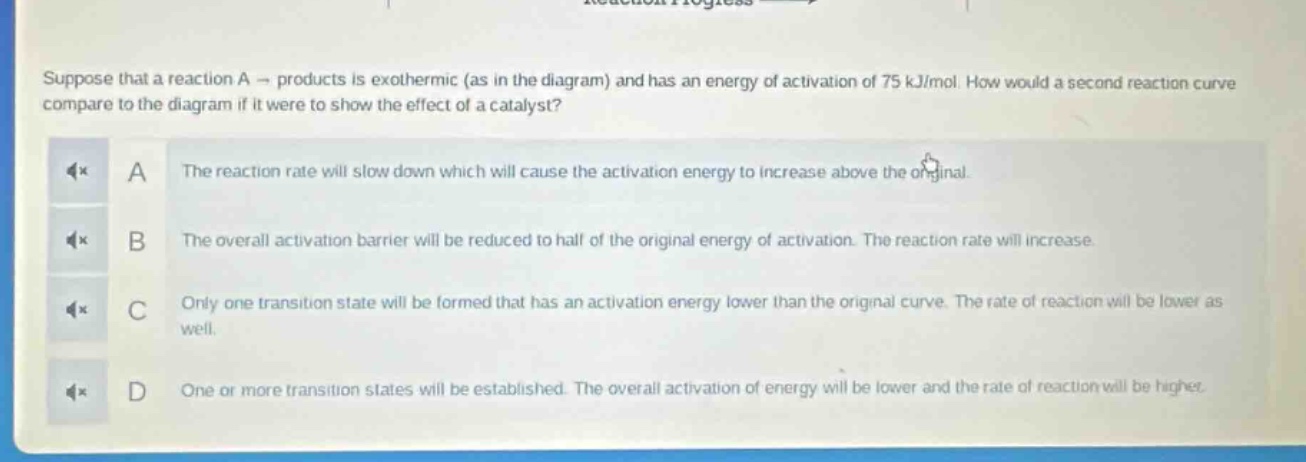
suppose that a reaction a → products is exothermic (as in the diagram) and has an energy of activation of 75 kj/mol. how would a second reaction curve compare to the diagram if it were to show the effect of a catalyst?\na the reaction rate will slow down which will cause the activation energy to increase above the original.\nb the overall activation barrier will be reduced to half of the original energy of activation. the reaction rate will increase.\nc only one transition state will be formed that has an activation energy lower than the original curve. the rate of reaction will be lower as well.\nd one or more transition states will be established. the overall activation of energy will be lower and the rate of reaction will be higher.
Answer
Brief Explanations:
A catalyst works by providing an alternative reaction pathway with a lower activation energy. This can involve the formation of one or more transition - states with lower energy requirements. As a result, the reaction rate increases. Option A is incorrect because a catalyst speeds up the reaction, not slows it down. Option B is incorrect as there is no rule that the activation energy is reduced to half. Option C is incorrect because a catalyst increases the reaction rate, not decreases it.
Answer:
D. One or more transition states will be established. The overall activation of energy will be lower and the rate of reaction will be higher.