table salt is the result of a(n) _____.\n○ ionic bond\n○ hydrogen bond\n○ covalent bond
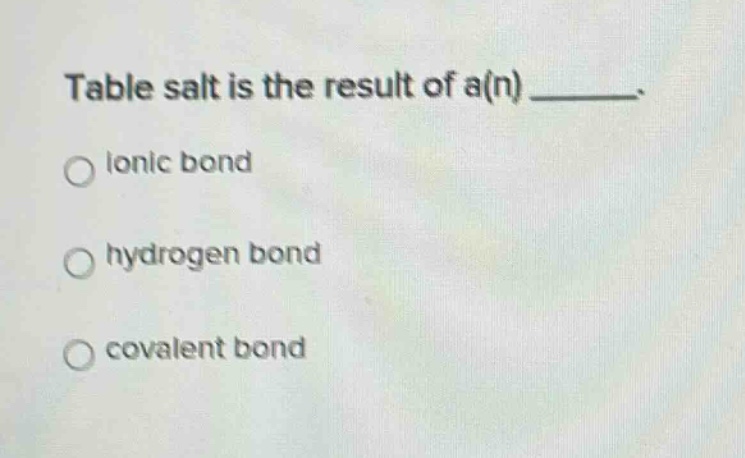
table salt is the result of a(n) _____.\n○ ionic bond\n○ hydrogen bond\n○ covalent bond
Answer
Brief Explanations:
Table salt (sodium chloride, NaCl) forms when sodium donates an electron to chlorine. This creates a positively - charged sodium ion and a negatively - charged chloride ion. Oppositely charged ions attract each other, forming an ionic bond. Hydrogen bonds are between polar molecules involving hydrogen and a highly electronegative atom like N, O, or F. Covalent bonds are formed by sharing electrons between atoms.
Answer:
A. Ionic bond