table 2 standard enthalpies of formation (kj/mol)\n| compound | $delta h_{f}^{circ}$ (kj/mol) | compound |…
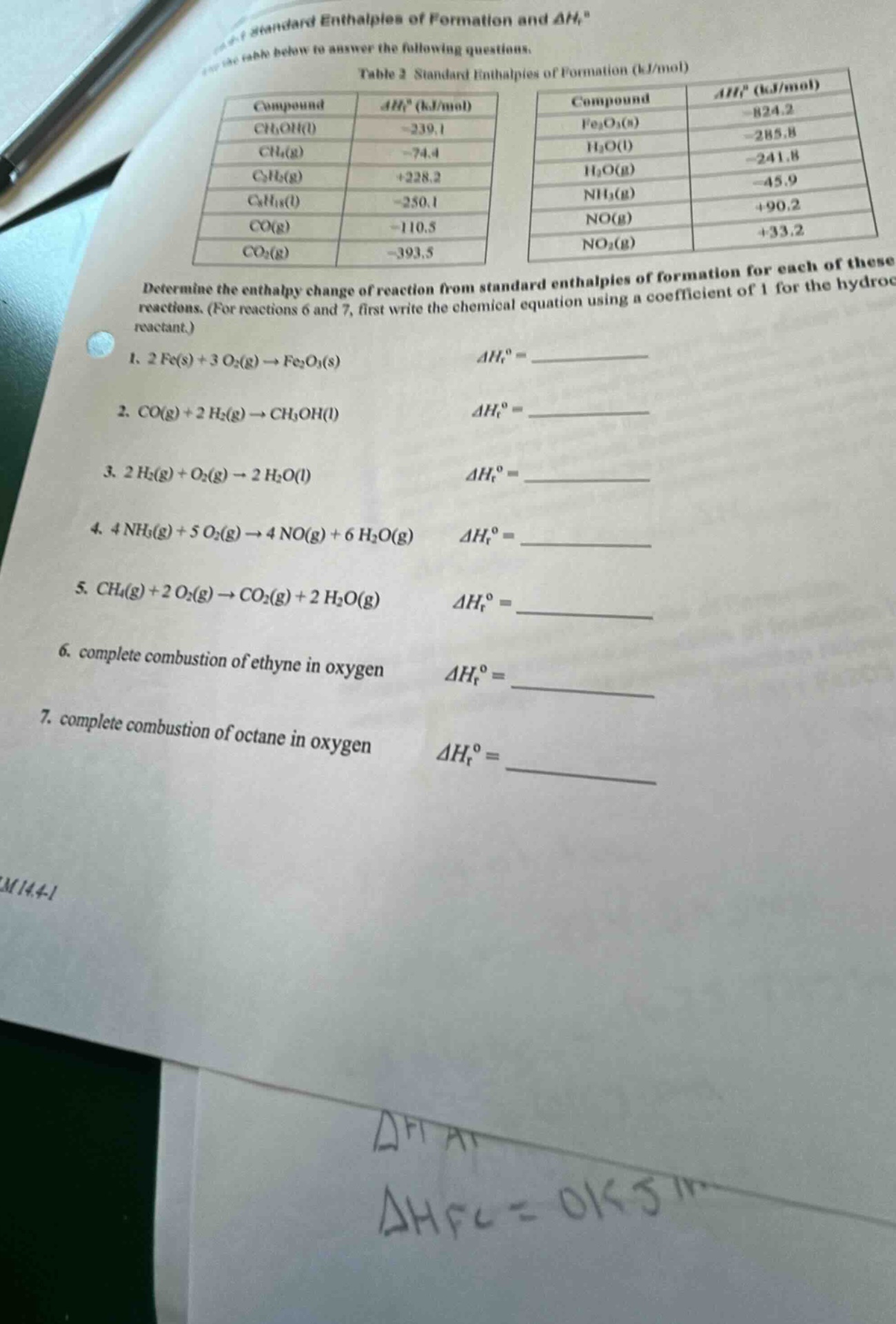
table 2 standard enthalpies of formation (kj/mol)\n| compound | $delta h_{f}^{circ}$ (kj/mol) | compound | $delta h_{f}^{circ}$ (kj/mol) |\n| ---- | ---- | ---- | ---- |\n| $ch_{3}oh(l)$ | -239.1 | $fe_{2}o_{3}(s)$ | -824.2 |\n| $ch_{4}(g)$ | -74.4 | $h_{2}o(l)$ | -285.8 |\n| $c_{2}h_{6}(g)$ | +228.2 | $h_{2}o(g)$ | -241.8 |\n| $c_{8}h_{18}(l)$ | -250.1 | $nh_{3}(g)$ | -45.9 |\n| $co(g)$ | -110.5 | $no(g)$ | +90.2 |\n| $co_{2}(g)$ | -393.5 | $no_{2}(g)$ | +33.2 |\ndetermine the enthalpy change of reaction from standard enthalpies of formation for each of these reactions. (for reactions 6 and 7, first write the chemical equation using a coefficient of 1 for the hydrocarbon reactant.)\n1. $2fe(s)+3o_{2}(g)\rightarrow fe_{2}o_{3}(s)$ $delta h_{r}^{circ}=$ ________\n2. $co(g)+2h_{2}(g)\rightarrow ch_{3}oh(l)$ $delta h_{r}^{circ}=$ ________\n3. $2h_{2}(g)+o_{2}(g)\rightarrow 2h_{2}o(l)$ $delta h_{r}^{circ}=$ ________\n4. $4nh_{3}(g)+5o_{2}(g)\rightarrow 4no(g)+6h_{2}o(g)$ $delta h_{r}^{circ}=$ ________\n5. $ch_{4}(g)+2o_{2}(g)\rightarrow co_{2}(g)+2h_{2}o(g)$ $delta h_{r}^{circ}=$ ________\n6. complete combustion of ethyne in oxygen $delta h_{r}^{circ}=$ ________\n7. complete combustion of octane in oxygen $delta h_{r}^{circ}=$ ________
Answer
Explanation:
The enthalpy change of a reaction ($\Delta H_r^\circ$) is calculated using the standard enthalpies of formation ($\Delta H_f^\circ$) of reactants and products: $$ \Delta H_r^\circ = \sum n \Delta H_f^\circ (\text{products}) - \sum m \Delta H_f^\circ (\text{reactants}) $$ where $n$ and $m$ are the stoichiometric coefficients. The $\Delta H_f^\circ$ for elements in their standard state is 0 kJ/mol.
1. $2 \text{ Fe(s)} + 3 \text{ O}_2\text{(g)} \rightarrow \text{Fe}_2\text{O}_3\text{(s)}$
Step1: Apply Hess's Law formula.
$\Delta H_r^\circ = [1 \times \Delta H_f^\circ(\text{Fe}_2\text{O}_3\text{(s)})] - [2 \times \Delta H_f^\circ(\text{Fe(s)}) + 3 \times \Delta H_f^\circ(\text{O}_2\text{(g)})]$
Step2: Substitute values and calculate.
$\Delta H_f^\circ(\text{Fe}_2\text{O}_3\text{(s)}) = -824.2 \text{ kJ/mol}$ $\Delta H_f^\circ(\text{Fe(s)}) = 0 \text{ kJ/mol}$ $\Delta H_f^\circ(\text{O}_2\text{(g)}) = 0 \text{ kJ/mol}$ $$ \Delta H_r^\circ = [1 \times (-824.2)] - [2 \times 0 + 3 \times 0] = -824.2 \text{ kJ/mol} $$
2. $\text{CO(g)} + 2 \text{ H}_2\text{(g)} \rightarrow \text{CH}_3\text{OH(l)}$
Step1: Apply Hess's Law formula.
$\Delta H_r^\circ = [1 \times \Delta H_f^\circ(\text{CH}_3\text{OH(l)})] - [1 \times \Delta H_f^\circ(\text{CO(g)}) + 2 \times \Delta H_f^\circ(\text{H}_2\text{(g)})]$
Step2: Substitute values and calculate.
$\Delta H_f^\circ(\text{CH}_3\text{OH(l)}) = -239.1 \text{ kJ/mol}$ $\Delta H_f^\circ(\text{CO(g)}) = -110.5 \text{ kJ/mol}$ $\Delta H_f^\circ(\text{H}_2\text{(g)}) = 0 \text{ kJ/mol}$ $$ \Delta H_r^\circ = [1 \times (-239.1)] - [1 \times (-110.5) + 2 \times 0] = -239.1 - (-110.5) = -128.6 \text{ kJ/mol} $$
3. $2 \text{ H}_2\text{(g)} + \text{O}_2\text{(g)} \rightarrow 2 \text{ H}_2\text{O(l)}$
Step1: Apply Hess's Law formula.
$\Delta H_r^\circ = [2 \times \Delta H_f^\circ(\text{H}_2\text{O(l)})] - [2 \times \Delta H_f^\circ(\text{H}_2\text{(g)}) + 1 \times \Delta H_f^\circ(\text{O}_2\text{(g)})]$
Step2: Substitute values and calculate.
$\Delta H_f^\circ(\text{H}_2\text{O(l)}) = -285.8 \text{ kJ/mol}$ $\Delta H_f^\circ(\text{H}_2\text{(g)}) = 0 \text{ kJ/mol}$ $\Delta H_f^\circ(\text{O}_2\text{(g)}) = 0 \text{ kJ/mol}$ $$ \Delta H_r^\circ = [2 \times (-285.8)] - [2 \times 0 + 1 \times 0] = -571.6 \text{ kJ/mol} $$
4. $4 \text{ NH}_3\text{(g)} + 5 \text{ O}_2\text{(g)} \rightarrow 4 \text{ NO(g)} + 6 \text{ H}_2\text{O(g)}$
Step1: Apply Hess's Law formula.
$\Delta H_r^\circ = [4 \times \Delta H_f^\circ(\text{NO(g)}) + 6 \times \Delta H_f^\circ(\text{H}_2\text{O(g)})] - [4 \times \Delta H_f^\circ(\text{NH}_3\text{(g)}) + 5 \times \Delta H_f^\circ(\text{O}_2\text{(g)})]$
Step2: Substitute values and calculate.
$\Delta H_f^\circ(\text{NO(g)}) = +90.2 \text{ kJ/mol}$ $\Delta H_f^\circ(\text{H}_2\text{O(g)}) = -241.8 \text{ kJ/mol}$ $\Delta H_f^\circ(\text{NH}_3\text{(g)}) = -45.9 \text{ kJ/mol}$ $\Delta H_f^\circ(\text{O}_2\text{(g)}) = 0 \text{ kJ/mol}$ $$ \Delta H_r^\circ = [4 \times (90.2) + 6 \times (-241.8)] - [4 \times (-45.9) + 5 \times 0] $$ $$ \Delta H_r^\circ = [360.8 - 1450.8] - [-183.6] = -1090.0 + 183.6 = -906.4 \text{ kJ/mol} $$
5. $\text{CH}_4\text{(g)} + 2 \text{ O}_2\text{(g)} \rightarrow \text{CO}_2\text{(g)} + 2 \text{ H}_2\text{O(g)}$
Step1: Apply Hess's Law formula.
$\Delta H_r^\circ = [1 \times \Delta H_f^\circ(\text{CO}_2\text{(g)}) + 2 \times \Delta H_f^\circ(\text{H}_2\text{O(g)})] - [1 \times \Delta H_f^\circ(\text{CH}_4\text{(g)}) + 2 \times \Delta H_f^\circ(\text{O}_2\text{(g)})]$
Step2: Substitute values and calculate.
$\Delta H_f^\circ(\text{CO}_2\text{(g)}) = -393.5 \text{ kJ/mol}$ $\Delta H_f^\circ(\text{H}_2\text{O(g)}) = -241.8 \text{ kJ/mol}$ $\Delta H_f^\circ(\text{CH}_4\text{(g)}) = -74.4 \text{ kJ/mol}$ $\Delta H_f^\circ(\text{O}_2\text{(g)}) = 0 \text{ kJ/mol}$ $$ \Delta H_r^\circ = [1 \times (-393.5) + 2 \times (-241.8)] - [1 \times (-74.4) + 2 \times 0] $$ $$ \Delta H_r^\circ = [-393.5 - 483.6] - [-74.4] = -877.1 + 74.4 = -802.7 \text{ kJ/mol} $$
6. Complete combustion of ethyne in oxygen
Step1: Write balanced combustion equation.
Ethyne is $\text{C}_2\text{H}_2$. Combustion with $\text{O}_2$ yields $\text{CO}_2$ and $\text{H}_2\text{O}$. $$ \text{C}_2\text{H}_2\text{(g)} + \frac{5}{2} \text{ O}_2\text{(g)} \rightarrow 2 \text{ CO}_2\text{(g)} + \text{H}_2\text{O(g)} $$
Step2: Apply Hess's Law formula.
$\Delta H_r^\circ = [2 \times \Delta H_f^\circ(\text{CO}_2\text{(g)}) + 1 \times \Delta H_f^\circ(\text{H}_2\text{O(g)})] - [1 \times \Delta H_f^\circ(\text{C}_2\text{H}_2\text{(g)}) + \frac{5}{2} \times \Delta H_f^\circ(\text{O}_2\text{(g)})]$
Step3: Substitute values and calculate.
Assuming the table value for "$\text{C}_2\text{H}_6\text{(g)}$" (+228.2 kJ/mol) is intended for ethyne ($\text{C}_2\text{H}_2\text{(g)}$) as per the question. $\Delta H_f^\circ(\text{C}_2\text{H}_2\text{(g)}) = +228.2 \text{ kJ/mol}$ $\Delta H_f^\circ(\text{CO}_2\text{(g)}) = -393.5 \text{ kJ/mol}$ $\Delta H_f^\circ(\text{H}_2\text{O(g)}) = -241.8 \text{ kJ/mol}$ $\Delta H_f^\circ(\text{O}_2\text{(g)}) = 0 \text{ kJ/mol}$ $$ \Delta H_r^\circ = [2 \times (-393.5) + 1 \times (-241.8)] - [1 \times (228.2) + \frac{5}{2} \times 0] $$ $$ \Delta H_r^\circ = [-787.0 - 241.8] - [228.2] = -1028.8 - 228.2 = -1257.0 \text{ kJ/mol} $$
7. Complete combustion of octane in oxygen
Step1: Write balanced combustion equation.
Octane is $\text{C}8\text{H}{18}$. Combustion with $\text{O}_2$ yields $\text{CO}_2$ and $\text{H}_2\text{O}$. $$ \text{C}8\text{H}{18}\text{(l)} + \frac{25}{2} \text{ O}_2\text{(g)} \rightarrow 8 \text{ CO}_2\text{(g)} + 9 \text{ H}_2\text{O(g)} $$
Step2: Apply Hess's Law formula.
$\Delta H_r^\circ = [8 \times \Delta H_f^\circ(\text{CO}_2\text{(g)}) + 9 \times \Delta H_f^\circ(\text{H}_2\text{O(g)})] - [1 \times \Delta H_f^\circ(\text{C}8\text{H}{18}\text{(l)}) + \frac{25}{2} \times \Delta H_f^\circ(\text{O}_2\text{(g)})]$
Step3: Substitute values and calculate.
$\Delta H_f^\circ(\text{C}8\text{H}{18}\text{(l)}) = -250.1 \text{ kJ/mol}$ $\Delta H_f^\circ(\text{CO}_2\text{(g)}) = -393.5 \text{ kJ/mol}$ $\Delta H_f^\circ(\text{H}_2\text{O(g)}) = -241.8 \text{ kJ/mol}$ $\Delta H_f^\circ(\text{O}_2\text{(g)}) = 0 \text{ kJ/mol}$ $$ \Delta H_r^\circ = [8 \times (-393.5) + 9 \times (-241.8)] - [1 \times (-250.1) + \frac{25}{2} \times 0] $$ $$ \Delta H_r^\circ = [-3148.0 - 2176.2] - [-250.1] = -5324.2 + 250.1 = -5074.1 \text{ kJ/mol} $$
Answer:
- $\Delta H_r^\circ = -824.2 \text{ kJ/mol}$
- $\Delta H_r^\circ = -128.6 \text{ kJ/mol}$
- $\Delta H_r^\circ = -571.6 \text{ kJ/mol}$
- $\Delta H_r^\circ = -906.4 \text{ kJ/mol}$
- $\Delta H_r^\circ = -802.7 \text{ kJ/mol}$
- $\Delta H_r^\circ = -1257.0 \text{ kJ/mol}$
- $\Delta H_r^\circ = -5074.1 \text{ kJ/mol}$